Showing posts with label Tips. Show all posts

Monday, August 10, 2015

World Building(Blocks)

Into the Realm of World Building!

The biggest payoff of comprehensive world building? The more you KNOW your world, the easier it will be to weave setting and voice into your text without the dreaded info-dump.

There! My number one take-away. :) Read on if you want to know more about the world building techniques that got me going.
This level of world building is new to me. My last fantasy took place solely in the woods. As a geeky kid who spent a lot of time in the woods looking under rocks, catching toads and such, that world came pretty easy-peasy. But with this WIP, I've got castles, taverns, stables, and a plethora of other places where I *wish* I spent more time. I started this story with a cast of characters and a basic plot, but when I tried drafting a chapter outline-- I couldn’t.  I didn’t know the world I was dropping them into. To complete an outline, I realized I needed more detail in four areas; what became my very basic world-building blocks: geography, history, technology/magic/paranormal, and culture. 


4 STEPPING-OFF points that got me started: 


Geography

This is was the first area that tripped up my outlining. I have two feuding parties. Were they a day’s-ride away from each other, or a week-at-sea away from each other? I needed a map. I tried drawing a map.  I learned this is not my forte.  Luckily, sites like Wikipedia really helped with this one. It turns our very own planet has plenty of inspirational islands, continents and borders- both geographical and political. The accompanying articles on Wikipedia also provide lots of ideas for goods, trades routes, locations for cities, etc.  

Whether you’re on a space station, pirate ship, horse carriage or land speeder, it helps to know where you are, where you’re going, and what could stop you.  

History

As previously stated, this WIP has two feuding parties, so history is a big one for me. Knowing the background and points-of-view of both parties is important for authentic voice and story continuity. 

There are likely very unique circumstances that led all our protagonists to where they are in life. Generally speaking:
WHY is their world the way it is? WHO is in power? WHO wants to be in power?

I drafted a timeline for my world, it’s very over-arching and dates back about 300 years, because that’s when my inciting incident (aka feud-fuel) occurred. I also needed to chart out the political/social hierarchy of the two groups.  Nothing is concrete, of course. Much of this “structure” could change by chapter three. :)

Technology, Magic, and the Paranormal

As Sci-Fi/Fantasy/Paranormal/Horror writers, we dabble in the fantastical because it’s FUN. Mermaids, psychic aliens, cursed relics—these things are imagination candy. That said, there should be boundaries, right? It’s no fun if a protagonist can cast a spell to save the adventure party whenever needed. Magic should probably come at a cost.  Same with technology. Most readers like a nugget of reality to draw on. In Jurassic Park, Michael Crichton gave us dino DNA encased in amber. In Ender’s Game, Orson Scott Card allotted for the passage of time on Earth while Ender traveled through space. In The Monstrumologist series, Rick Yancey creates a frightening balance between myth and science. 
"The Monstrumologist" by Rick Yancey (2009) Simon & Schuster. 

Will the gods play a role in your world?  Aliens? Bacteria? If so, become an expert. It’s about consistency in your writing, which leads to the reader buying in. The more familiar you are with these elements, the easier it will be to drop details into your story without the dreaded info dump.  
 

Culture

This is where you can fill a notebook with cool and unique nuggets that make this world your own. Think slang, clothing, food, art, music, social structure, values, customs, religion. My experience was that bits of culture presented themselves to me while I hammered out the above three areas, but once I had a better grasp on those elements the ideas for culture really started coming. 

But maybe for you, the cultural mores of an imagined society are enough to build your world around. What works for you? Is there a book you think epitomizes excellent world creation? Share with us below! 

Monday, April 20, 2015

Author Interview: Michelle Smith


Visit author Michelle Smith's website.

We are so thrilled and honored to feature writer, critique group member, mental health advocate, and all-around awesome human,  Michelle Smith.  

Michelle’s debut novel YA novel, PLAY ON, is now available as an e-book and will be out in print on April 21st. 


First, an intro to PLAY ON: 

PLAY ON
In the small town of Lewis Creek, baseball is everything. Especially for all-star pitcher Austin Braxton, who has a one-way ticket out of town with his scholarship to a top university. All that stands between him and a new start is one final season. But when Austin starts flunking Chemistry, his picture-perfect future is in jeopardy. A failing grade means zero playing time, and zero playing time means no scholarship.

Enter Marisa Marlowe, the new girl in town who gets a job at his momma’s flower shop. Not only is Marisa some home-schooled super-genius, she’s also a baseball fanatic and more than willing to help Austin study. As the two grow closer, there’s something about Marisa that makes Austin want more than just baseball and out of Lewis Creek–he wants a future with her. But Marisa has a past that still haunts her, one that she ran all the way to South Carolina to escape.

As Austin starts to peel back the layers of Marisa s pain, it forces him to look beyond the facade of himself and everyone he thought he knew in his town. What he sees instead is that in a small town like Lewis Creek, maybe baseball isn’t everything–maybe it is just the thing that ties them all together.


RW: We have so many questions for you! But, we also know you are crazy busy with your release day (!!!) so we’ll try to keep it together. Let’s talk about your debut! You’ve mentioned PLAY ON is the book of your heart. Could you share what makes this story so dear to you?

MS: I think because it comes from such a personal place. It probably sounds cheesy, but so much of my heart and soul went into those pages. There are thoughts that I never thought I should share—thoughts that I didn’t know I could share. The idea for this book was in the works for a long time, until I finally worked up the nerve to start writing it. And I’m really glad I did! 

RW: I think many writers feel a sense of vulnerability putting their words out into the world. Not only have you jumped that hurdle, you’ve gone a leap further and opened up about yourself, authoring posts for outstanding sites like To Write Love on Her Arms and, don’t bleed. breathe. Can you tell us about the decision to share your personal experiences? 

MS: The primary reason is so others will realize that they’re not alone. 

When I was going through the thick of depression, I was convinced that no one could possibly understand what my head was doing. That I was broken, that I was scarred, that I was beyond reaching. That there was no possibility for this to go anywhere but down. Depression is a very convincing liar, and it’s easy to believe those lies. So I want others to know that, while depression is so very dark and painful, there is hope, and the darkness doesn’t last forever. 

RW: As critique partner, we’re all constantly amazed by your voice.  Your characters always ring true, so vivid and memorable. Can you share a little about your character development process? Character sketches? Channeling spirits? How do you do it?! 

MS: Good gracious, I adore you guys.

I just…write people? Haha! My stories are always characters first, and I love to dive into their heads, to feel what they’re feeling, to say what they’re thinking. I will say that some characters are a little more difficult to connect with at first. In my most recent WIP, I was called out for boxing myself and my characters in, which was completely justified (I kind of realized I was doing it while writing). So my editor sent me a character development worksheet that was 8 pages long (I am not even kidding), and I just went to work. I was able to dig into them a little deeper, and it helped immensely. 

RW: We’ve got a great thing going here at RW: a blogging platform with a built-in critique group (often times support group!). But joining a critique group can be a daunting endeavor. Can you share what made you decide to reach out to the writing community?

MS: My first experience ever working with a beta reader was back in my fan fiction days. She nitpicked my grammar, let me know when my characters were being waaaaay too unrealistic, and told me when I could do so much more with a story when I tried to play it safe.

I loved her for it. And five years later, she’s still one of my closest friends. She’s also the one who talked me into writing my first book.

Critique makes you a better writer—it’s really that simple. Yes, critique can be difficult to handle in the beginning, especially if you have paper-thin skin, but it’s a necessity. Sometimes we nail a scene. Sometimes our chapters need work. And sometimes our entire book need a re-write. As writers, we often get too close to a story, and we’re unable to see the things that just aren’t working. Outside eyes help. 

All that said, it is important to find a critique group that matches your style—some readers are brutally honest, and some are more gentle guiders. The one necessity is that you find a group that’s honest. We absolutely need cheerleaders; we also need people who’ll give it to us straight, and won’t let us get away with anything less than our best.

Needless to say, I’m so happy I found you guys. 

RW: Can you share any deets about upcoming projects?

MS: Very, very little deets at this time. But I will say that we haven’t seen the last of Lewis Creek and its baseball boys. ;)

RW: More from Lewis Creek? YES! Okay, final question—and this is incredibly important—what is it that makes Dean Winchester so damn compelling?  *pause for moment of reflective sighing*

MS: *cracks knuckles* Now you’re speaking my language.

We have pie.


We have the Impala.


We have his love for Sam…


And Castiel.


We have the heartbreaking moments.


And we have general badassery. 


All that to say:


RW: You’re the best Michelle!!! 

MS: YOU are. 

About Michelle:

Michelle Smith was born and raised in North Carolina, where she developed a healthy appreciation for college football, sweet tea, front porches, and a well-placed “y’all.” She’s a lover of all things happy, laughs way too much, and fully believes that a little bit of kindness goes a long way.
Michelle lives near the Carolina coast with her family.

Connect with Michelle:   Website | Twitter | Facebook | Tumblr

Monday, March 30, 2015

What's Your Excuse

Happy Monday, guys and gals! I'm going to chat with you about something that you very well may already be familiar with, but I wanted to throw it out there for those of you who may be new to the writing community or maybe just new to podcasts in general.

If you write genre fiction, especially sci fi and/or fantasy, then you probably already listen to the Writing Excuses podcast. Buuuuuut on the off chance that you haven't had the pleasure, you should seriously think about checking it out.

It's a once a week, 15 min long (give or take) podcast about writing, and it's run by some really cool folks, namely Mary Robinette Kowal, Brandon Sanderson, Dan Wells, and Howard Tayler. Maybe you've heard of them?? The podcast is fun, informative, full of fabulous guest authors, and it's short, so you're not wading through 45 mins of off topic banter before getting to the good stuff.

Season 10 began in January and, taken from the shows transcript: "Each month will focus on a specific bit of the writing process, and each podcast will drill down on one of those bits."

I've enjoyed following along so far this year! And even though it's nearly April, the back episodes, plus all 9 previous seasons are available for your listening pleasure via the archives on their website.

Right now, they're digging into story structure, which is a topic I'm always fascinated by. I really enjoyed today's episode, and I thought maybe you would too.

So if you want to check it out, here's the link: http://www.writingexcuses.com/

Happy Listening!

Sunday, January 18, 2015

4 Tips To Get Your Story Back On Track

Every choice your character makes leads to whatever is going to happen next. As an author—the evil mustache-twirling mastermind behind the story – figuring out what that thing is will undoubtedly fall somewhere between semi-perplexing and bang head against the wall until your eyes cross. And it will happen over and over and over again, because what are stories if not a constant string of What Comes Nexts?

So how do we wade through the murky territory of story decisions without turning into Artax in the Swamp of Sadness—overwhelmed and despairing that we’ll never come up with a kick ass plot?


I won’t tell you that I know the 7 words that will make a woman love you* how to eradicate Swamp of Sadness Syndrome, but I can share a few tips that may help you out if your story gets stuck.

1)      Goals & Motivation.

In the current scene, what does your character want and why do they want it? This is the first thing I look at when my characters start bumbling around and the plot feels like it’s going nowhere. A good amount of the time, I’ve lost sight of what the characters want and why any of it matters. Making sure this is clear on the page and focusing your scene around it will go a long, long way toward getting things back on track.
2)      Conflict.

If you have lost sight of your characters goals and motivations, chances are there’s not a lot of conflict going on either. Things can’t really oppose your characters in a meaningful way if they aren’t actively working toward something. Once you’ve reacquainted yourself (and the story) to # 1, it’s a lot easier to find inherent conflicts to torture your characters with.

3)      Stakes.

Your characters can have a goal and firm motivations for achieving it. Things can stand in their way — even big scary things with lots of sharp teeth – but if your characters have nothing to lose if they fail, any conflict you establish will feel contrived. The reader won’t care whether the characters achieve the scene goal. So, if  you don’t a ton of work setting up Goals, Motivation, and Conflict but you feel like your scene is still falling flat, it might be time to reexamine what your characters have at stake if they fail and make sure that it’s coming across on the page.

4)      Putting it all together.

In my opinion, this can be the hardest part because on the scene level, there might be several options goals, motivations, conflicts, and stakes. If I’m going to get really, truly stuck, there is where and when it happens.

So how do you decide THE BEST course of action? If you’re anything like me, it’s right about now that you:

* stare at the screen
* write a few words
* stare anxiously at what you wrote
* pound the delete key
* gorge self on *insert favorite snack and/or wine here*
* wash, rinse, repeat, and/or decide that you totally suck at life and go watch TV instead
* sink into the Swamp of Sadness

Here’s what I’ve figured out, though. Your stuckness (yeah, I know stuckness isn’t a real word) isn’t for lack of NOT know what comes next. Which, is actually a pretty awesome problem to have, because nine times out of ten there are bunches of possibilities floating around in your head. I call this brain freeze. It’s a state of being overwhelmed by too many potential story paths, and the only solution is to sit down and sort it all out.  

This is when I bust out the pen and paper and move away from the computer. Ladies and Gentlemen, it’s time for the What If list.

I don’t why, but I have to write “What if…” before every idea I have, like a promise to myself that whatever I come up with is only a suggestion that I’m in no way obligated to run with. Now I’m ready to put it all down, bullet point style. What if character makes X decision? Then I note the possible outcomes. Or what about if she makes X decision instead? Then I note those outcomes. I do this for all the possible choices I can think up.

Next, I pick the most intriguing options and bullet point their consequences, conflicts, and what my character stands to gain or lose from making that choice. Eventually, I find myself with one or two options that really take off. Connections between what I’ve already written and what I’ve outlined for future chapters are made.

If, by the end of this process, there’s still more than one really good choice, I evaluate each based on steps 1, 2, & 3 in relation to the current scene and also the story as a whole. Which path aligns itself more closely to the direction I want the plot to take?  99.9% of the time, I’ve not only worked out what I need to happen next, but I can’t wait to start writing it!

*Bonus points if you get the reference and say so in the comments. J


Monday, December 15, 2014

Staying Committed

Snowflake via Alexey Kljatov

The HOLIDAYS are upon us! With all that goes on with kids and their schools, work parties, friend parties, traveling, vacations, and the shopping, it's hard to stay focused and committed to writing and editing. Since NaNo, I've made many lofty goals for revising only to be waylaid by sickness, surprise family emergencies, and doctor visits. My goals have basically been dashed to pieces. Just looking at my to-do lists make me want to pull all my hair out.

Here are some helpful tips if you are experiencing the same kind of busy life and insane scheduling:

  •  Keep breathing. This helps a LOT. 
  • Count your blessings and remember that good things can happen! This makes a smile appear on my face. 
  • Divide and conquer! Instead of revising 10 chapters in a week, cut it half, and then maybe cut it in half again if need be. Stress is not a writer's BFF, unless it is. Procrastinators unite! 
  • Prioritize. Drop the extra baggage whenever and wherever possible. If it can wait, sneak 20 minutes of writing in! 
  • Practice focusing. As a mom, this can be difficult for me. I have noodle-brain syndrome and think of a million things at once. Try honing in on that ms by making a playlist or reread the previous couple of paragraphs to get your mind set on the words.
  • Ask for help! You'd be surprised how many people want you to succeed in your endeavors! Let them be a part of it by wrapping some gifts or picking up some stocking stuffers for you. Or ask for a night or two of peace and quiet as your holiday gift! 
  • Don't fret. Eventually, things get done. You'd be surprised how often I feel like I'm barely keeping my head above water and then it's New Years! We can do this! I believe in you!

So, dare I ask what your goals are during the holidays? Please share!

Happy Holidays!!

Monday, December 1, 2014

Tackling that Revision

Happy Monday!

We are in DECEMBER! I'll give you a minute to freak out about that.


We've also reached the end of NaNoWriMo. If you won: GOLD STAR FOR YOU. If you participated, but didn't quite reach 50k: GOLD STAR FOR YOU. Because you got words on the page. And even if it wasn't 50k words, it's more than you had on October 31st. That's something to be darn proud of.

Now, if you DID reach 50k, or even reached the end of your novel, you're solid, right? Eh. Maybe. Maybe not. It kind of irks me when people scream DON'T YOU DARE THINK YOU'RE FINISHED. More than likely, you're not. Generally speaking, first drafts are for getting the words out. Revision is turning those words into what you dreamed they would be.

In December 2013, I started what would become my biggest revision project yet (helloooo, my precious PLAY ON). And while it was most definitely hard work, I ended up with a book that I am so very proud of. I'm no expert, but I do have a few tips on how to tackle a major revision.

Be open to change.

This is the number one step. If you’re not ready to change anything, then you’re probably not ready to revise. Finishing your draft is awesome! But revision is where the magic happens. If you don’t think you need to change anything in your first draft, I suggest letting your manuscript sit for at least a week or so--heck, come back to that baby after the holidays, if need-be. When you return with fresh eyes, you may be surprised at the things you find.

Know what needs to be done.

When I get notes from my CPs/agent/editor, the first thing I do is make a list of each issue that needs addressing. This way, I can check them off as I go.

Make an attack plan.

This is where outlining comes in handy. It doesn’t have to be some long, drawn-out, 10-page outline. Simply jotting down main plot points can be super helpful. The point here is that you need to know where you're going.

Have a support system. And chocolate. And pie.

There may be tears. And that's okay. This writing stuff gets tough. Sometimes, you just need someone else to tell you that you CAN do this, even if you don't believe it yourself. Trust me.

Embrace the "mental health days."

We’re not robots. We have brains and bodies that need rest. Burnout is a real thing that sucks. I, for one, love my mental health days. If you need a night of Netflix and brownies, go for it. Your MS will wait for you.

Be patient with yourself.

Again, it's tough. And the first round of revisions may not be "it." You may need two rounds. Three. Seven. But once you're holding a manuscript that's everything you'd hoped it would be, all the work is so, so worth it.

Monday, October 27, 2014

Lost that Lovin' Feeling?

Before we jump in, I’ve recently discovered something: a majority of my posts are either pep talks, or advice on how to get through being stuck.

I GET STUCK A LOT, FOLKS.

But I think that’s normal. Roadblocks in a manuscript can come from so many different things: your plot may have taken a wrong turn down a dead-end road; you may be hitting a complete blank on what happens next; good, old-fashioned fear may have you paralyzed. And then there's the super-sad explanation: you just don’t feel the connection to your story. 

I’m working on a new WIP, and I’ve hit every single one of these roadblocks over the past month. Hard times in the Smith house, y’all. So, I dug into my arsenal of roadblock-bashing material. The most recent blockage I hit was that super-sad one I mentioned: lack of connection to the story. One thing I’ve come to embrace is the Manuscript Love List. I can't take credit for this one; I got the idea from Stephanie Perkins.

Here's the idea: you make a list of all the things you love about your manuscript. Easy, right? It may sound super-basic and you may be wondering how that can possibly help, but I urge you to give it a try—you may be surprised! For example, here are a few of the love list items from my upcoming YA Contemporary, PLAY ON.

Ponds
Starry skies
Flowers
Pick-up trucks
Wide-open fields
Baseball games during cool springtime nights

I jotted these down in the early stages of the story, and as the story grew, so did my list. Just reading over the things I love about the story gets me into the mindset of its atmosphere and, most importantly, of why I wanted to write it in the first place. So if you’re stuck, give it a try! You may just fall in love all over again. J


Monday, October 6, 2014

Tackling Goals


Gotta love football! 


For me, the fall is a super crazy, busy time of year. Last week, I sat down and made a list of the most important things that needed to get done. This turned into some real goal setting since I plan on participating in NaNoWriMo in November again! Yay! :)

When planning goals there are a few things to consider:

  1. What can you realistically accomplish? Think long and hard about it.
  2. Create a timeline for the project(s). 
  3. Be specific. Finishing a novel in a month is great, but without the details, it might flop.
  4. Design benchmarks to measure your project and keep things running in a timely manner.
  5. Accountability! Set up specific times to check in with someone who will encourage you to stay on track. 
If you have big dreams, try whittling them down to what your schedule allows or to what you know you can do easily. Think on a daily, weekly, monthly basis. Divide and conquer! Check out Rina's mini task list blog; it's amazing. Sometimes those monstrous, looming projects are easier to manage in small doses! A back-up list is always great to have on hand too if you find you've achieved your goals ahead of schedule. 

And even though accountability is the last on the list, it's one of the most important things! When you share your dreams and ask others to either help by giving you the time to do them, or ask you about them, just the asking can keep you trekking toward your accomplishment. Whether it's telling your CPs, best friend, mom, or significant other, letting them know what's important to you encourages them to support you! Ask around, you could gain an accountability partner and be one for someone else.

So.... What do you want to accomplish before the end of 2014? We love hearing from you! :)

Monday, September 8, 2014

Nurture Your Inner Outliner


With die hard pantsers on the far left hand of the scale and hardcore plotters on the far right, chances are you fall somewhere in between. I want to start out this post by saying that whatever amount of pantsing or plotting you do, if it works for you, you’re in good shape.

This is NOT a post about the RIGHT way to get a story started, because a right way doesn’t exist. If you poll 100 writers about their process, you’ll get 100 different answers as evidenced by the My Writing Process Blog Tour.

Click here to read about how our own RW’s do it. And click here if you want to check out how hundreds of other authors get there stories rolling.

If you haven’t landed on a process that works for you and you’ve wanted to try plotting more seriously, this post might help with that. Or at the very least, it may give you some ideas that you can take in your own direction.

So here’s a little about me and my pantser-wishing-I-were-a-plotter woes.

I’ve been a plotter wannabe for a long time, because for me, pantsing has led to a lot of rewriting. I happen to be one of those folks who loves revision with the burning intensity of a thousand suns. But drafting? Meh. It’s hard for me translate ideas into actual words. Ideas are big. Words are tiny, and you need a lot of them to complete a novel.

Don’t get me wrong, my love for words rivals my love for Christmas, and coffee, and chocolate combined. It’s just that my preference leans toward making them pretty during revision. Andplusalso, I have a hard time turning off my internal editor, which can make the drafting phase slower than it needs to be. I recently tweeted this and it's something I have to remind myself of often.


Another thing I love is story structure. At first I thought, I can just keep all this structure stuff in my head while I trail blaze a first draft, but the more I learned about structure, the more I realized how directly related it is to having a sold plot BEFORE I begin to write. I guess sometimes I need to learn my lessons the hard way. But before I dive into the details of how I plotted my new WIP, here's a few things that changing my process has helped with:

  • Working out a solid story structure
  • Visual representation of events timeline and whether they are feasible or require adjusting (this one was a biggie)
  • Staggering reveals and plot twists for maximum impact (another biggie)
  • Setting up reveals and twists with appropriate foreshadowing
  • Ensure subplots are organically woven throughout the entire story
  • Connecting plot threads
  •  Discovering gaps in logic
  •  Uncovering plot holes before they turn into problems
  •  Creating strong character arcs
  • Identifying weak spots and making them stronger
  •  Establishing strong GMC’s (goals, motivation, conflicts) for every character
  • Can efficiently draft out of sequence, because I know what needs to happen in every scene and how they’re connected (yet another biggie)
  • Will *hopefully* minimize the necessity for major rewrites during revision

This list is by no means all-inclusive, but those are some of the really big issues that plotting allowed me to tackle up front. Now, let’s get on to the main event.

I’ve always wanted to use index cards and create a grandiose storyboard, but kept stalling out because writing in actual ink seemed too permanent when I knew things were going to change. I did some research and tried out several online cork boards. The two I like the best are Spaaze and Popplet.

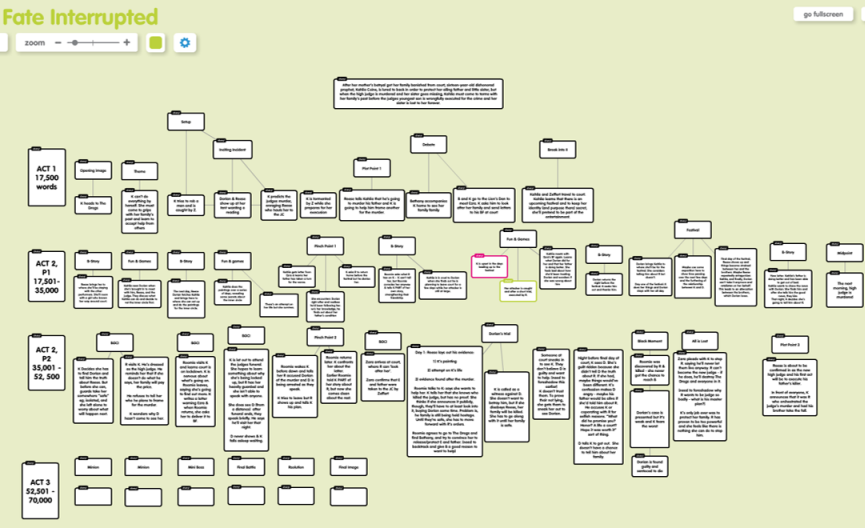
Both are free, easy to use, and have excellent features. I ended up using Popplet because it’s simple and I didn’t want designing the board to draw focus away from designing my plot. With Popplet, you create little bubbles that can be connected together. It doesn't get much simpler than that.

So here's what I did. AKA The Process
(At the bottom of this section, there’s a pic of what the *mostly* final board looks like)

Step 1) I wrote a few sentences about each scene I knew would be in the book. Each scene got its own little bubble. 

I’m a fan of 3 Act structure, because it gives me a reference for where things need to happen and keeps the story pacing on target. For instance, if I’m shooting for a 70K word novel, I want the first act to take approximately ¼ of my total word count, which brings me to:

Step 2) I created 4 new bubbles: ACT 1, ACT 2 Part 1, ACT 2 Part 2, and ACT 3. Then I sorted my scene bubbles beside the act I felt they would fall into.

I also really like the Save the Cat beat sheet. Just like with using 3 Act structure, Blake Snyder’s beat sheet helps me pace reveals and plot points so they are staggered throughout each act. Writer and blogger Jamie Gold has an awesome downloadable beat sheet, which she adjusted for novel writers. (Plus she has bunch of other goodies there as well, so you should totally check it all out.)

Step 3) I created new bubbles for each beat I wanted to hit in the book and used them as headers, connecting them with the scenes I’d already included.

At this stage, I didn’t have enough ‘beat’ scenes written yet. This was my first clue that had I already started writing, I’d be missing essential story elements that I wanted to include. I was thrilled to discover this now instead of later.

Step 4) Filled in the remaining beats with new scenes.

Step 5) Evaluated the big picture with a focus on the timeline of events and reordered and/or added new scenes in order to create a realistic timeline. 

Ex: there’s a section of the story where the POV character needs to write and receive a series of letters. It’s a day and a half journey one way from sender to receiver, and I realized that in my budding outline I had letters coming and going WAY too quickly. She was receiving replies to her correspondence before her letter could have reached its reader. This could have been a giant problem had I figured this out after completing the first draft. I got off my butt and happy danced over discovering and fixing this issue ahead of time.

Step 6) I looked at scenes that were weak. These said something vague like: Two days pass leading up to (event) and MC is upset about X. I fleshed these out into actual scenes and found that these were good spots to advance the subplot, which at that point was still pretty light.

Step 7) Checked all major plot points, reveals, pinch points, and twists were evenly spaced and adjusted where necessary. (And oh, there was lots of adjusting)

Step 8) Once the main plot, sub plot, and timeline were solid and evenly paced, I considered other details like where more foreshadowing was needed in order to build to certain reveals, and I added notes about which scenes could support that info.

Step 9) A little estimating is required here. I evaluated each scene and decided whether it was enough to support an entire chapter or whether it needed to be connected with the scene beside it. Knowing about how long my chapters run and my aim for the final word count of this book, I estimated needing at least thirty chapters to get me to The End.  I was close, but needed a little more and spent some time seeing what could be added to either make new scenes or flesh out existing scenes into standalone chapters.

*When I was finished and ready to move onto phase two, my Popplet looked like this:


(Note 1: yes, Act 3 is empty. Endings are my nemesis and I simply cannot fully plot them out in advance. So even though I’m hardcore plotting this book, there will still be some pantsing involved.)

(Note 2: this process took about a week to complete

Step 10) I did this part in MS Word due to a heartbreaking loss of work in Scrivener that I haven’t completely recovered from. *wipes away fresh tears*

Personally, I’m not good at working with two documents. Now that I had everything plot-wise setup, I wanted to transfer it to my working document. If you’re working in Word, the navigation pane is your best friend. Learn it, live it, love it. For reals. If you’re not familiar with the navigation pane, there are lots of tutorials out there. Bottom line is that you need to use headers to make it work for you. Doing this allows you to jump around your document without wearing out your mouse’s scroll bar.

I modified my heading styles to look like this


New Act’s are heading 1, all standard chapters are heading 2, a plot point or pinch point chapter is header 3 or 4 respectively, and my outline and any other documents notes I add are heading 5.
Then I typed in my Act numbers and chapter headers in their appropriate headings, and then copied and pasted each scene from Popplet under the chapter it belongs with. When that was done, my navigation pane looked like this:


 Setting up the document this way makes moving around it easier, which is a huge time saver once the word count begins adding up. Pasting each scene from Popplet into Word was a bit tedious, however in long run, I’m glad I did it. I can click on anything in the navigation pane and jump straight to that section. When I get there, I know exactly what I need to write about. 

I’d never written out of order before, because as a pantser, I had only a bleary idea of what would happen a scene or two past what I was currently working on. This time, I felt confident skipping from chapter 7 to chapter 20, because my outline is solid and I’ve already justified the inclusion of every single scene.

I'm finding the freedom to work on any story section I choose is incredibly freeing. Some days, an emotion-heavy scene might be right up my alley, but on another day, I’m too drained to dig as deep as that sort of scene demands. Now I have options, and my word count is increasing much faster than when I my only choice was to write scenes in order.

Aaaand, that’s it. I’ll just add a quick shout out to a few of my favorite books on plot and structure. Save the Cat and Save the Cat Strikes Back by Blake Snyder. Story Engineering by Larry Brooks. The Hero’s 2 Journeys by Michael Hauge and Christopher Vogler. And lastly, K.M. Weiland’s entire blog, but especially her Structuring Your Scenes series, which is ah-fricken-mazing.

I know this was a long post, and I appreciate you guys sticking with me. I hope you found something in here that’s helpful. Now go forth and write all the words!


Monday, August 4, 2014

Tackling a Major Revision

Happy Monday!

In December 2013, I started what would become my biggest revision project yet. And while it was most definitely hard work, I ended up with a book that I am so very proud of. I'm no expert, but I do have a few tips on how to tackle a major revision.

Be open to change.

This is the number one step. If you’re not ready to change anything...well, you’re not ready to revise. Finishing a draft is awesome! But revision is where the magic happens. If you don’t think you need to change anything in your first draft, I suggest letting your manuscript sit for at least a week or so. When you come back with fresh eyes, you may be surprised at the things you find.

Know what needs to be done.

When I get notes from my CPs/agent/editor, the first thing I do is make a list of each issue that needs addressing. This way, I can check them off as I go.

Make an attack plan.

This is where outlining comes in handy. It doesn’t have to be some long, drawn-out, 10-page outline. Simply jotting down main plot points can be super helpful. The point here is that you need to know where you're going.

Have a support system. And chocolate.

Because there may be tears. And that's okay. This writing stuff gets tough.

Embrace the "mental health days."

We’re not robots. We have brains and bodies that need rest. Burnout is a real thing that sucks. I, for one, love my mental health days. If you need a night of Netflix and brownies, go for it. Your MS will wait for you.

Believe that you can do this.

Again, it's tough. And the first round of revisions may not be "it." You may need two rounds. Three. Seven. But once you're holding a manuscript that's everything you'd hoped it would be, all the work is so, so worth it.

Monday, June 30, 2014

Michelle's (Current) Top 4 Revision Tips

I’ve been in a constant stage of revision since December. That’s almost SEVEN MONTHS, you guys. Granted, it's been between two different stories, but my brain has been in overdrive. The end is in sight, though, and now I’m here to share my top four revision tips.

-         Promises made, promises kept.
This was a big one for me. When you spend a while with a particular manuscript, you may forget that tiny mention you made in chapter one. If you introduce a plot point into the story (promise made), even if it’s minor, make sure it’s resolved by the end of the story (promise kept). Don’t gyp your reader.

-         Each character has a mind of his/her own.
We don’t want cardboard cutouts. It’s so easy and convenient to let a secondary character (or even a main character) fall into a stereotype. And sometimes the stereotype can be valid (there are mean cheerleaders, etc.), but don’t take the easy way out. Everyone has a personality--let it shine.

-         The underneath is just as important as what’s on the surface—maybe even more so.
As much as I love dialogue, there has to be more to a story than people talking to each other. Giving the reader a peek into the character’s thoughts, even by inserting one or two lines, can make all the difference. If you have chunks of dialogue throughout the manuscript, consider adding a bit of internal thought. (Note that I said "consider." Too much internal monologue can hurt a scene's flow. It's a delicate balance. Use it wisely.)

-         Give yourself some grace.
It’s easy to fall into the trap of “I’m not working fast enough.” Trust me, I know this all too well. STOP IT. Creating something great takes time. Think about your CP for a moment. If they came to you crying and said, “I’m a failure. I missed three days of revision last week and I’m so far behind. You don’t even know,” what would you tell that person? Would you nod and say, “Yeah, you pretty much suck”? No. (Well, I hope not.) You’d (hopefully) tell that person not to be so hard on themselves. Do the same for yourself.

Monday, June 16, 2014

My Writing Process Blog Hop

You guys! The amazing Michelle Smith  has tagged us in the My Writing Process blog hop. But before we get on with sharing our answers, please click on over to Michelle’s blog and check out her #DoSomething challenge that’s going on throughout the month of June.

#DoSomething is all about spreading kindness through simple everyday actions. You can find out more about it here and catch up on challenge #1 and #2 here and here. As Michelle says on her blog: 

“The world can be scary. It’s also full of wonder and love and hope. Let’s focus on the latter.”


Okay, now on to our Creature Double Feature.


1)     What am I working on?

Diane: Currently, I'm putting the final polish on my YA fantasy before submitting to agents and editing a YA sci-fi.

Rina: I’m currently working on a sequel to my middle grade fantasy, RULES OF RODENTIA. In Book Two, well… geez, I can’t really say too much without giving away parts of Book One! But rest assured, the deep woods are still a perilous place and there are some tasks only a young mouse like Tobin can handle.

Marlana: I'm working on a YA contemporary titled, AND THE BAND PLAYS ON from dual POVs.  The pitch: Sixteen-year old trumpet playing Frannie experiences her first crush when Ali moves into the neighborhood. He's like no one she's ever met -- tall, dark and...damn! Ali is upset to be uprooted from Orlando, leaving his friends and soccer team behind. So no one is more surprised than he when he begins thinking of Warrenstown, WV as home. Then on 9/11, America is attacked and the terrible tragedy that unites the townsfolk also outcasts Ali, his family, and anyone who associates with them.

Cheryl: I’ve been torn between two YA projects for a while—a straight up fantasy and something that’s leaning toward light sci-fi. As of late, though, the fantasy, entitled FATE INTERRUPTED, seems to have won the battle for my attention. Here’s the pitch:

In a country sharply divided between honor classes, Dorian Van Zander, youngest son of the high judge, crosses paths with prophet Kahlia Coine. Kahlia’s paintings illustrate her patrons’ futures, and she predicts Dorian will succeed his father after the high judge is murdered. Kahlia knows the future isn’t a suggestion, it’s a force, and once set on a path, there is no stopping it. But promises of a higher honor class for herself, her younger sister, and her ailing father lure her to court where she’ll attempt to alter the fate of Dorian’s family and her own.

Kahlia begins eliminating members of the high-court as pre-murder suspects, but publically displaying their secrets puts her own life in danger. Despite her low status, friendship between Kahlia and Dorian blossoms into something more, but the connection Kahlia discovers between herself and the judge’s inevitable demise threatens to rip away the life she’s always desired and the love she never knew she wanted.

2)     How does my work differ from others of its genre?  

Diane: Though my books are similar to what is out there in the genre, I haven't read anything exactly like them. The worlds are unique and so are the characters.

Rina: I think the biggest difference in my current work vs. other MG fantasy is the cast of rodents, snakes, and other critters who take center-stage. RULES OF RODENTIA is about the journey of a young mouse trying to ensure his family’s survival in the forest. Life is tough when you’re only two inches tall. Aside from letting the critters communicate with each other, I do try to keep a sense of realism. Tobin can’t cast a spell to transport himself to the spider den to save his baby brother; he needs to track the spider’s trail across the woods. 

Marlana: My husband is from Morocco and together we're raising two amazing boys. My husband and children are Muslim. I'm often surprised at some of the assumptions made about children with an Islamic upbringing. I felt I could bring unique insight into the home of a Muslim teen and what they experienced before and after the 9/11 attacks.  AND THE BAND PLAYS ON is my third novel and I can seriously say, it's the first time the words seem to pour directly from my soul to the page.

Cheryl: Yikes, this question is a toughie! I always want my settings to add another level of conflict to the plot instead of just being a backdrop for it. While most of what I write leans toward the fantastical, I try to make sure that there is lots of depth and richness to my world building, drawing on the characters culture, politics, and most importantly their world views that color everything related to both setting and plot. The places may spawn from my imagination, but I want them to feel as real and believable as possible and so intrinsically tied to the plot that the reader couldn't imagine the story taking place anywhere else. 


3)     Why do I write what I do?


Diane: I love speculative fiction! Always have. The first book that caught my attention was The Hero and the Crown by Robin McKinley in seventh grade. I fell in love with the world she created. It was a great escape. I try to fashion that same feeling in the novels I write. YA is a fun genre too. There's so much happening in life during the teenage years that stick with us for the rest of our lives. My characters go through lots of exciting changes and make some tough decisions.

Rina: As to why I like writing Middle Grade, it’s because adult minds tend to muck up even the simplest ideas. Typically, if you ask a grown-up a question, like if animals have feelings, you tend to get a big, drawn out response. I like skipping through all that nonsense and diving right into a story.  
Just today there was a story on the morning news about a mysterious ocean creature eating a 9 foot-long, Great White Shark. The shark was swallowed whole. Scientists are scratching their heads and I LOVE THAT. There’s mystery in this world, and that is what I like to think about. What ate that shark? A giant squid? A megalodon? Something we’ve never seen because that trench the shark was pulled into is so, SO deep?  Take it further—what if a ten year old girl won a science fair scholarship and got to accompany a research vessel, and they picked up a strange blip! on their radar…

Marlana: It was after I finished HARRY POTTER AND THE DEATHLY HOLLOWS that I wrote my first novel, a MG fantasy titled THE ALLIANCE OF MISFITS. I was so upset to say goodbye to Harry, Ron, and Hermione that I needed new characters to cope with the loss. My second novel, a YA Sci-fi titled THE GATHERERS, was outlined after a Star Trek marathon on Netflix. My protagonist, Paxton, appeared in my dreams and insisted I write her story. Finally, my WIP is something I've wanted to write for over a decade, but have been too afraid. With the encouragement of my critique groups and the upcoming 15th year anniversary of the horrific attacks, I knew it was time.

Cheryl: I think my voice lends itself well to YA. Besides that, though, I truly adore everything about YA literature. For me, it comes down to figuring out the world and where our special brands of crazy fit into it. The world and everyone in it is always evolving. Nothing stays static forever, so figuring out how we fit into the grand scheme of things is something (I think) readers of all ages can connect with. And then there’s the kissing. Because…KISSING! Duh!


4)     How does my writing process work?


Diane: I write whenever I can! With my first novel, it took me a while to figure out how everything was going to work in the world I'd envisioned. I did several rewrites and heavy revisions. But the second book just popped up in my brain. I also wrote it during NaNo, which was new for me, but it was a fantastic experience! I got so much done in such a short time.

Rina: I wrote RULES OF RODENTIA, Book One, chapter by chapter, plodding forward because that’s what felt natural. Working on the sequel is a different story (no pun intended). This time I’m outlining the book first, making sure I have the right story arcs coming together, points of character growth, and sprinkles of tension in the right places. There are a couple story lines that cross over from Book One, so it’s helping me keep things straight.

Marlana: Great question. And my answer? No idea! It's going to sound ridiculous, but seriously -- there are times my fingers are striking the keyboard and I'm reading the words filling the paper like it's someone else's work. I have zero idea how those words got there or where they've come from. I tend to write in chapters although I've been known to jump ahead and write a few scenes that have come to me -- typically while taking a shower, that I don't want to forget.  Then once I've written a chapter, I go back, edit it and then write the next chapter. Then I start at chapter one (AGAIN), edit it, edit the second chapter and then write chapter three and so on. You can imagine how tedious this becomes and it takes until I'm about ten chapters in before I make my OCD self stop starting from the beginning.

Cheryl: Ugh! Another tough question. ;) My writing process changes depending on any number of things. Sometimes I outline. Other times, not so much. Sometimes I write daily. Other times… you guessed it. Not. So. Much.

I can tell you this though, it can be frustrating if you dwell on the how or the why too much. For example, after finishing the novel I’m currently querying, I had a hard time falling in love with a new premise, set of characters, world, etc. I had lots of ideas, but the whole writing them down thing wasn’t happening. It drove me crazy because until that point, I was SO excited to start on something new. Stalling out felt like failure of the epic variety.

Très Stressful, I assure you.

Thing is though, it wasn’t because the ideas weren’t good, which of course was my big fear. Turns out, I just needed time to get better acquainted with them. And the longer these new characters and conflicts and setting percolated in my head, the closer I got to putting my fingers to keyboard. Once the story had built itself up to bursting from my head, the writing part took care of itself. Sometimes you just have to trust your brain to know what it needs and go with it. At the end of the day, telling an awesome story is all that matters, regardless of the process.

 
Up next are the lovely writers below. Please stop by their blogs and check out their posts next week.


I am writing toward publication, Taekwondo-ing toward a black belt, parenting toward sending seven grown-ups into the world, and wife-ing toward happily ever after. I think I have a thing for goals.


José is a Cuban-American writer and math teacher living in Epcot with his wife Lisa and their two teenage kids. Stories of his have appeared in STRANGE HORIZONS and STUPEFYING STORIES, and his novels for young adults are represented by Cameron McClure of the Donald Maass Literary Agency.


Reading and writing have always been second nature for me. They are as integral to me as the air I breathe and the words I speak. I knew from a very young age that I would grow up to work with words in some capacity. I thought, perhaps I'll be a librarian. No, a literary agent. How about a copywriter? But the entire time, my heart would whisper, "you're going to be an author." In August of 2013, I released my first novel The Right Kind of Wrong and have since published Whiskey and a Gun (a prequel novella) and Capricious (a short story). My next novel, The Finish will release in 2014.