Showing posts with label Cheryl. Show all posts

Monday, September 21, 2015

HAPPY NEW YEAR


In case you’re wondering, no, I haven’t completely lost it.  To me, Fall always feels like the writer’s new year. 

Picture it: you’re sitting at your computer or laptop, all snuggled up in your comfy sweater and  nestled into your favorite writing spot. A crisp breeze floats in through your window, carrying the scent of cut grass and turning leaves. You sip hot coffee or tea from your very best mug and begin outlining your shiny new NaNo project – Ahhhhhhh! It’s heaven, yes?

There is just something about this time of year that gets me in the right frame of mind for writing, whether it’s tackling that old story that just wouldn’t come together last Spring, or that sparkly new idea that’s been stalking my thoughts all Summer. Perhaps I’m romanticizing it, but how can *ALL THE IDEAS* not happen when you’re sitting on the porch in the perfectly cool air, notebook and pen in hand, scribbling out notes and drinking a decadent glass of merlot or shiraz? Just thinking about it makes my fingers itch to clack, clack, clack on the keyboard! 

I’ll be back at a project that I’m in love with but needed some time away from in order to put things into better perspective. And I don’t know if it’s the new season or not, but I’m uber excited to dive back into it.

So happy writer’s new year, everyone. May the words flow, may your characters come to life, and may your plotting be full of awesome. Huzzah!

Monday, May 4, 2015

Words, Glorious Words


There are bunches of reasons why I decided to start writing, but I today I’m going to stick with just one: WORDS. I love ‘em. 

When I hear something funny, a beautiful description, or a phrase that skillfully encapsulates a feeling, I’m smitten by both the content and by the arrangement of words themselves.

There’s so many ways to say a thing! When you’re trying to perfectly capture a specific sight, sound, or emotion, the vast options of words, and the millions of ways you can arrange them, can be exciting. It can also be a bit paralyzing at times, though.

It’s like dumping out all the pieces of a hundred different puzzles onto a table, and then trying to fit together a single matching row.

When I’m stuck and can’t for the life of me land on the right word, one of the first things I do is look over my words list. Yup, that’s right. I collect words. J  The words come from all over—people speaking IRL, T.V. shows, books—and the words I keep can stand alone or be an entire sentence. 

Of course, I don’t use other people’s constructions in my work, but sometimes I need inspiration that only a fantastic sentence can provide.

I keep a list on my phone that’s simply titled Word List. (Super Original, I know.) Here’s a few things I’ve put aside for future consideration:

Blight

Hoist

A devil’s expression

Trying out the shape of his mouth on my lips

The list goes on and on, and my friends have grown used to me saying “Ooh, that was good. It’s definitely going on the list."


So tell me, do you have any word fetishes, like maybe you sleep with a thesaurus under your pillow? Or…um, something. ;D  

Monday, March 30, 2015

What's Your Excuse

Happy Monday, guys and gals! I'm going to chat with you about something that you very well may already be familiar with, but I wanted to throw it out there for those of you who may be new to the writing community or maybe just new to podcasts in general.

If you write genre fiction, especially sci fi and/or fantasy, then you probably already listen to the Writing Excuses podcast. Buuuuuut on the off chance that you haven't had the pleasure, you should seriously think about checking it out.

It's a once a week, 15 min long (give or take) podcast about writing, and it's run by some really cool folks, namely Mary Robinette Kowal, Brandon Sanderson, Dan Wells, and Howard Tayler. Maybe you've heard of them?? The podcast is fun, informative, full of fabulous guest authors, and it's short, so you're not wading through 45 mins of off topic banter before getting to the good stuff.

Season 10 began in January and, taken from the shows transcript: "Each month will focus on a specific bit of the writing process, and each podcast will drill down on one of those bits."

I've enjoyed following along so far this year! And even though it's nearly April, the back episodes, plus all 9 previous seasons are available for your listening pleasure via the archives on their website.

Right now, they're digging into story structure, which is a topic I'm always fascinated by. I really enjoyed today's episode, and I thought maybe you would too.

So if you want to check it out, here's the link: http://www.writingexcuses.com/

Happy Listening!

Sunday, January 18, 2015

4 Tips To Get Your Story Back On Track

Every choice your character makes leads to whatever is going to happen next. As an author—the evil mustache-twirling mastermind behind the story – figuring out what that thing is will undoubtedly fall somewhere between semi-perplexing and bang head against the wall until your eyes cross. And it will happen over and over and over again, because what are stories if not a constant string of What Comes Nexts?

So how do we wade through the murky territory of story decisions without turning into Artax in the Swamp of Sadness—overwhelmed and despairing that we’ll never come up with a kick ass plot?


I won’t tell you that I know the 7 words that will make a woman love you* how to eradicate Swamp of Sadness Syndrome, but I can share a few tips that may help you out if your story gets stuck.

1)      Goals & Motivation.

In the current scene, what does your character want and why do they want it? This is the first thing I look at when my characters start bumbling around and the plot feels like it’s going nowhere. A good amount of the time, I’ve lost sight of what the characters want and why any of it matters. Making sure this is clear on the page and focusing your scene around it will go a long, long way toward getting things back on track.
2)      Conflict.

If you have lost sight of your characters goals and motivations, chances are there’s not a lot of conflict going on either. Things can’t really oppose your characters in a meaningful way if they aren’t actively working toward something. Once you’ve reacquainted yourself (and the story) to # 1, it’s a lot easier to find inherent conflicts to torture your characters with.

3)      Stakes.

Your characters can have a goal and firm motivations for achieving it. Things can stand in their way — even big scary things with lots of sharp teeth – but if your characters have nothing to lose if they fail, any conflict you establish will feel contrived. The reader won’t care whether the characters achieve the scene goal. So, if  you don’t a ton of work setting up Goals, Motivation, and Conflict but you feel like your scene is still falling flat, it might be time to reexamine what your characters have at stake if they fail and make sure that it’s coming across on the page.

4)      Putting it all together.

In my opinion, this can be the hardest part because on the scene level, there might be several options goals, motivations, conflicts, and stakes. If I’m going to get really, truly stuck, there is where and when it happens.

So how do you decide THE BEST course of action? If you’re anything like me, it’s right about now that you:

* stare at the screen
* write a few words
* stare anxiously at what you wrote
* pound the delete key
* gorge self on *insert favorite snack and/or wine here*
* wash, rinse, repeat, and/or decide that you totally suck at life and go watch TV instead
* sink into the Swamp of Sadness

Here’s what I’ve figured out, though. Your stuckness (yeah, I know stuckness isn’t a real word) isn’t for lack of NOT know what comes next. Which, is actually a pretty awesome problem to have, because nine times out of ten there are bunches of possibilities floating around in your head. I call this brain freeze. It’s a state of being overwhelmed by too many potential story paths, and the only solution is to sit down and sort it all out.  

This is when I bust out the pen and paper and move away from the computer. Ladies and Gentlemen, it’s time for the What If list.

I don’t why, but I have to write “What if…” before every idea I have, like a promise to myself that whatever I come up with is only a suggestion that I’m in no way obligated to run with. Now I’m ready to put it all down, bullet point style. What if character makes X decision? Then I note the possible outcomes. Or what about if she makes X decision instead? Then I note those outcomes. I do this for all the possible choices I can think up.

Next, I pick the most intriguing options and bullet point their consequences, conflicts, and what my character stands to gain or lose from making that choice. Eventually, I find myself with one or two options that really take off. Connections between what I’ve already written and what I’ve outlined for future chapters are made.

If, by the end of this process, there’s still more than one really good choice, I evaluate each based on steps 1, 2, & 3 in relation to the current scene and also the story as a whole. Which path aligns itself more closely to the direction I want the plot to take?  99.9% of the time, I’ve not only worked out what I need to happen next, but I can’t wait to start writing it!

*Bonus points if you get the reference and say so in the comments. J


Monday, December 8, 2014

Winning NaNo (even when you fail)


For the first time in many years, I participated in NaNoWriMo, and in doing so I learned a little something. 

Let me start by saying that I had stayed away from NaNo in years past because every time I tried to reach my 50K word goal, I failed. And even though I knew that 50K in a month was a giant task, (and one year my town lost power for eleven days after a major Halloween snowstorm) it stung to not meet the goals I had set for myself, especially when so many others seemed to cruise right through to the end. 

I didn’t just fail. I felt like a failure.


Even though I didn’t really think about it in these terms, feeling like a failure is what kept me from trying NaNo again. And thus, I broke up with NaNo in a very it’s not you, it’s me fashion.

Fast forward a few years to NaNo 2014. I’m about 20K into a new WIP that I’m pretty excited about, and I decide that I want to give NaNo another try. Maybe it would be just the thing I needed to finish that all important first draft so I could start fresh with revisions in 2015. 

Of course, the first thing I do is tell my CPs. Apparently, the stars were aligned just right that day as I found out that all of us intended to participate this year. Yippee!! We all vowed to support and cheer for each other. We talked about our goals and how we planned on accomplishing them. This had me super excited and shot my motivation bar up to 11. 

Next, I made a plan.  I knew myself much better than I did during NaNo’s past, and so I came up with a plan that would give me the best possible chance to win. Monday through Friday, I was going to go to bed at 7:00 pm and wake up at 4:00 am every morning. That would give me two hours to write before I had to get ready for The Day Job. 

It was going to be AWESOME.


And awesome it was. For a time. However, November is a notoriously busy month for my family. As November flew by, I fell behind.  And behind. Aaaaand behind. That old familiar feeling crept it’s way into my consciousness. Despite my best efforts, I’m failing. Then, I’m a failure.

However, this year, a bigger part of my brain squashed that train of thinking immediately. Maybe I won’t write 50K new words, but I HAD written new words. Quite a few of them actually, and I was damn proud of those words. I also realized that not meeting a goal in a certain time frame was NOT synonymous with failure. It’s not even close. NaNo (as well as most other things) is not about winning or losing, or judging your achievement by another person’s progress. 

When I used a different perspective to consider what I had accomplished -- I  wrote way more in November than I had any other month in 2014 – then in reality, I kicked NaNo’s a$$. I was a word producing machine! My NaNo 2014 was a major success. 50K or not, I could feel good about what I'd done and look forward to doing it again next year. 

Thinking this way is motivating instead of discouraging and demoralizing. If you don’t try, you can never succeed, so never beat yourself up for trying. 

So, I guess the point to my story is this – be proud of what you’ve done, not what you haven’t yet accomplished. Give yourself credit for trying. Learn from your experiences and, in the end, do the best you can and allow yourself to feel good about it. 


Monday, November 3, 2014

Do You have Creative Outlets Other Than Writing?


I’ve always felt like I have a creative brain. For me, that means there’s about a million things I want to do or want to learn how to do, and all these things compete for my attention. And while I think it’s great that I have all these interests and ambitions, it’s also frustrating.

Fact: There will never be enough time to do it all. *sad face*

So that means I've had to (for now) limit my non-writing activities. So when I'm not writing, I run an indie nail polish shop on Etsy called Wikid Nails, where I sell my handcrafted nail polish. If you follow on me on Twitter you may have seen one or two a lot of my manicure tweets. (Guys, I have a serious glitter addiction. Just sayin'.) And during the fall, I hawk my wares at some of the local craft fairs as well. 


I also love to knit and crochet. Mostly I make fingerless gloves, yoga socks, and slouchy hats that I sometimes sell, but mostly give as gifts to friends and family.


There’s magic in producing something that simply did not exist before I felt compelled to create it.

Take knitting. Even though I know how to fashion the stitches, I’m still boggled every time I finish a pattern and have a completed project. I think, how the heck did I turn a ball of yarn into a pair of fingerless mittens?

Answer: magic. Duh!

Unfortunately, there’s no pattern for writing a book. (though if someone could get on that, that’d be awesome.)


The principal is sort of the same though, if you liken words to stitches. You have to string them together, over and over, twisting them and turning them until they become more than the sum of their parts. It takes time and practice, and little bit of magic, and in the end, something new exists in the world that hadn’t before. And you made it happen. Ah-maze-ing!!

I'd love to hear about YOUR creative endeavors outside of writing. Bonus points if you're an Etsy seller, too. And if you are, leave a link in the comments. I'd love to check out your shop! 

Monday, September 8, 2014

Nurture Your Inner Outliner


With die hard pantsers on the far left hand of the scale and hardcore plotters on the far right, chances are you fall somewhere in between. I want to start out this post by saying that whatever amount of pantsing or plotting you do, if it works for you, you’re in good shape.

This is NOT a post about the RIGHT way to get a story started, because a right way doesn’t exist. If you poll 100 writers about their process, you’ll get 100 different answers as evidenced by the My Writing Process Blog Tour.

Click here to read about how our own RW’s do it. And click here if you want to check out how hundreds of other authors get there stories rolling.

If you haven’t landed on a process that works for you and you’ve wanted to try plotting more seriously, this post might help with that. Or at the very least, it may give you some ideas that you can take in your own direction.

So here’s a little about me and my pantser-wishing-I-were-a-plotter woes.

I’ve been a plotter wannabe for a long time, because for me, pantsing has led to a lot of rewriting. I happen to be one of those folks who loves revision with the burning intensity of a thousand suns. But drafting? Meh. It’s hard for me translate ideas into actual words. Ideas are big. Words are tiny, and you need a lot of them to complete a novel.

Don’t get me wrong, my love for words rivals my love for Christmas, and coffee, and chocolate combined. It’s just that my preference leans toward making them pretty during revision. Andplusalso, I have a hard time turning off my internal editor, which can make the drafting phase slower than it needs to be. I recently tweeted this and it's something I have to remind myself of often.


Another thing I love is story structure. At first I thought, I can just keep all this structure stuff in my head while I trail blaze a first draft, but the more I learned about structure, the more I realized how directly related it is to having a sold plot BEFORE I begin to write. I guess sometimes I need to learn my lessons the hard way. But before I dive into the details of how I plotted my new WIP, here's a few things that changing my process has helped with:

  • Working out a solid story structure
  • Visual representation of events timeline and whether they are feasible or require adjusting (this one was a biggie)
  • Staggering reveals and plot twists for maximum impact (another biggie)
  • Setting up reveals and twists with appropriate foreshadowing
  • Ensure subplots are organically woven throughout the entire story
  • Connecting plot threads
  •  Discovering gaps in logic
  •  Uncovering plot holes before they turn into problems
  •  Creating strong character arcs
  • Identifying weak spots and making them stronger
  •  Establishing strong GMC’s (goals, motivation, conflicts) for every character
  • Can efficiently draft out of sequence, because I know what needs to happen in every scene and how they’re connected (yet another biggie)
  • Will *hopefully* minimize the necessity for major rewrites during revision

This list is by no means all-inclusive, but those are some of the really big issues that plotting allowed me to tackle up front. Now, let’s get on to the main event.

I’ve always wanted to use index cards and create a grandiose storyboard, but kept stalling out because writing in actual ink seemed too permanent when I knew things were going to change. I did some research and tried out several online cork boards. The two I like the best are Spaaze and Popplet.

Both are free, easy to use, and have excellent features. I ended up using Popplet because it’s simple and I didn’t want designing the board to draw focus away from designing my plot. With Popplet, you create little bubbles that can be connected together. It doesn't get much simpler than that.

So here's what I did. AKA The Process
(At the bottom of this section, there’s a pic of what the *mostly* final board looks like)

Step 1) I wrote a few sentences about each scene I knew would be in the book. Each scene got its own little bubble. 

I’m a fan of 3 Act structure, because it gives me a reference for where things need to happen and keeps the story pacing on target. For instance, if I’m shooting for a 70K word novel, I want the first act to take approximately ¼ of my total word count, which brings me to:

Step 2) I created 4 new bubbles: ACT 1, ACT 2 Part 1, ACT 2 Part 2, and ACT 3. Then I sorted my scene bubbles beside the act I felt they would fall into.

I also really like the Save the Cat beat sheet. Just like with using 3 Act structure, Blake Snyder’s beat sheet helps me pace reveals and plot points so they are staggered throughout each act. Writer and blogger Jamie Gold has an awesome downloadable beat sheet, which she adjusted for novel writers. (Plus she has bunch of other goodies there as well, so you should totally check it all out.)

Step 3) I created new bubbles for each beat I wanted to hit in the book and used them as headers, connecting them with the scenes I’d already included.

At this stage, I didn’t have enough ‘beat’ scenes written yet. This was my first clue that had I already started writing, I’d be missing essential story elements that I wanted to include. I was thrilled to discover this now instead of later.

Step 4) Filled in the remaining beats with new scenes.

Step 5) Evaluated the big picture with a focus on the timeline of events and reordered and/or added new scenes in order to create a realistic timeline. 

Ex: there’s a section of the story where the POV character needs to write and receive a series of letters. It’s a day and a half journey one way from sender to receiver, and I realized that in my budding outline I had letters coming and going WAY too quickly. She was receiving replies to her correspondence before her letter could have reached its reader. This could have been a giant problem had I figured this out after completing the first draft. I got off my butt and happy danced over discovering and fixing this issue ahead of time.

Step 6) I looked at scenes that were weak. These said something vague like: Two days pass leading up to (event) and MC is upset about X. I fleshed these out into actual scenes and found that these were good spots to advance the subplot, which at that point was still pretty light.

Step 7) Checked all major plot points, reveals, pinch points, and twists were evenly spaced and adjusted where necessary. (And oh, there was lots of adjusting)

Step 8) Once the main plot, sub plot, and timeline were solid and evenly paced, I considered other details like where more foreshadowing was needed in order to build to certain reveals, and I added notes about which scenes could support that info.

Step 9) A little estimating is required here. I evaluated each scene and decided whether it was enough to support an entire chapter or whether it needed to be connected with the scene beside it. Knowing about how long my chapters run and my aim for the final word count of this book, I estimated needing at least thirty chapters to get me to The End.  I was close, but needed a little more and spent some time seeing what could be added to either make new scenes or flesh out existing scenes into standalone chapters.

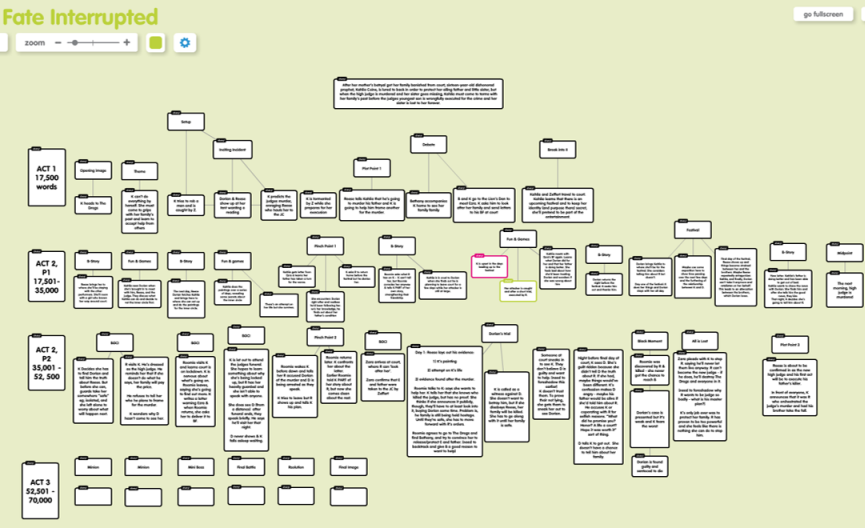
*When I was finished and ready to move onto phase two, my Popplet looked like this:


(Note 1: yes, Act 3 is empty. Endings are my nemesis and I simply cannot fully plot them out in advance. So even though I’m hardcore plotting this book, there will still be some pantsing involved.)

(Note 2: this process took about a week to complete

Step 10) I did this part in MS Word due to a heartbreaking loss of work in Scrivener that I haven’t completely recovered from. *wipes away fresh tears*

Personally, I’m not good at working with two documents. Now that I had everything plot-wise setup, I wanted to transfer it to my working document. If you’re working in Word, the navigation pane is your best friend. Learn it, live it, love it. For reals. If you’re not familiar with the navigation pane, there are lots of tutorials out there. Bottom line is that you need to use headers to make it work for you. Doing this allows you to jump around your document without wearing out your mouse’s scroll bar.

I modified my heading styles to look like this


New Act’s are heading 1, all standard chapters are heading 2, a plot point or pinch point chapter is header 3 or 4 respectively, and my outline and any other documents notes I add are heading 5.
Then I typed in my Act numbers and chapter headers in their appropriate headings, and then copied and pasted each scene from Popplet under the chapter it belongs with. When that was done, my navigation pane looked like this:


 Setting up the document this way makes moving around it easier, which is a huge time saver once the word count begins adding up. Pasting each scene from Popplet into Word was a bit tedious, however in long run, I’m glad I did it. I can click on anything in the navigation pane and jump straight to that section. When I get there, I know exactly what I need to write about. 

I’d never written out of order before, because as a pantser, I had only a bleary idea of what would happen a scene or two past what I was currently working on. This time, I felt confident skipping from chapter 7 to chapter 20, because my outline is solid and I’ve already justified the inclusion of every single scene.

I'm finding the freedom to work on any story section I choose is incredibly freeing. Some days, an emotion-heavy scene might be right up my alley, but on another day, I’m too drained to dig as deep as that sort of scene demands. Now I have options, and my word count is increasing much faster than when I my only choice was to write scenes in order.

Aaaand, that’s it. I’ll just add a quick shout out to a few of my favorite books on plot and structure. Save the Cat and Save the Cat Strikes Back by Blake Snyder. Story Engineering by Larry Brooks. The Hero’s 2 Journeys by Michael Hauge and Christopher Vogler. And lastly, K.M. Weiland’s entire blog, but especially her Structuring Your Scenes series, which is ah-fricken-mazing.

I know this was a long post, and I appreciate you guys sticking with me. I hope you found something in here that’s helpful. Now go forth and write all the words!