Different writers at different stages of the game, hammering away at revisions-- one page at a time. Now go forth and write ALL THE WORDS.
Showing posts with label writing tips. Show all posts
Tuesday, November 3, 2015
It's Time to Write!
It's November and that means that NaNoWriMo is here again! Have you signed up? Or do you hate it? There are so many differing opinions when it comes to writing until your fingers bleed on the keyboard each day!
Personally, I love NaNoWriMo. It gets the story I've been thinking about for months out of my brain and onto the page. I love the community and the pep talks from amazing authors. Don't get me wrong, November is an insanely busy month for me, but I manage to write that first, horrible draft every time.
This year, the amazing Kristina Van Hoose has posted a fabulous gathering of all the information you'd ever need to prepare for NaNoWriMo, or really any writing endeavor. Check it out here.
And in case you need more tips and tricks to pour over, here are a few things I do to survive NaNoWriMo:
I'm a minimalist when it comes to plotting and planning. I like to have a solid beginning, flexible middle, and possible end. As long as I have a general idea of what's going to happen, I let my characters do whatever they want. It is NaNoWriMo after all.
Once my very changeable plot is in place, I plan day to day. At the end of the day when I've written all the words my brain can stand to write, I write a little more. By adding a quick sentence or two, I plot the next day's writing. It might just be a scene or an entire chapter. As long as I have an idea of what I'm supposed to write, the writing usually gets done without major pauses or head smacking desk incidents. ;)
I also plan when I'm going to write each day. I steal time anywhere I can! If I'm waiting in the kid's pick-up line at school, I write a paragraph or two. If I have a break during lunch, I write a page or two. Most of my writing happens in the evening after the kids go to bed.
I like to prepare my family for NaNoWriMo too. I usually begin the conversation before Halloween just so everyone knows mommy will be checking out after bed time. Getting family and friends on board with my writing schedule is important! And I get to give them updates on my word count so they can cheer me on!
So if you haven't joined the madness, come on! Get that novel done! Even if you don't hit the 50K mark, you'll still have more words than 0 at the end of November!
Have a great tip? Please share! We love hearing from you!
Monday, September 7, 2015
Writer's Block
Writer's Block - the condition of not being able to think
of what to write or how to proceed with writing.
I recently experienced the worst case of writer's block I've
had since I became serious about writing. Sure, I've had moments when I've been
too busy to put down new words--kids' events, family vacations, work
commitments... But this was different. I literally sat in front of my pc screen for hours, my mind complete mush. So I reached out to
some of the most talented authors I know--my amazing friends and CP's. This is some
of what they suggested.
Tori Kelly: Reading helps me
every time. I always get inspired by seeing others who do it so well. Also, I never write scenes. This is a trick
Brian Farrey Latz shared at a SCBWI conference. Free yourself to write a scene that will never go into the book.
Mostly writer's block is about being too
much of a perfectionist.
Elle E. Ire told me
that when she experiences the dreaded block, she watches a show that inspires her, reads a book in its entirety, and / or forces herself to write a crappy scene
just to get through it. She might also jump ahead and write a later scene she
really wants to write to get going again and then go back and connect the dots.
Or she'll just let herself take a break from writing. Unless she has a deadline, she gives herself permission to do that once in awhile.
Vivi Barnes: When writer's block strikes, I have a glass of wine and watch mindless episodes of the Bachelor. Wish I was joking, but... In my opinion, having writer's block
isn't about having nothing to write about; it means that something isn't
working. Literally--a block. Look at what's stopping you and see if anything
can be adjusted. Cut a chapter out, go a different direction with a plot line,
head off the beaten path a bit and see if it makes a difference. If all else
fails, there's always the rest of the wine bottle and episodes of Bachelor in
Paradise!
Rina Heisel recommends taking a
walk alone, reading in a similar genre (and think to yourself as you read
through it--how would you do it), or binge watching an awesome TV show. Also, she
says you must allow yourself to partake in these activities GUILT FREE
reminding that it's really an investment in your process.
Diane Bohannan: I force
myself to sit alone with the computer. We stare at each other for a long time.
Then I type whatever comes to mind. It isn't always a story or a blog,
sometimes it's just thoughts. Let the thoughts move in whatever direction they
want to go. Write anything and don't judge yourself on what comes out. The
first stuff might not be wonderful, but it'll uncork your brain.
There are tons of fantastic blogs online with great tips. Peggy J Sheridan directed me to this awesome article author Dorian Cirrone wrote on kicking writer's block. Here's another great post by author Nathan Bransford explaining why he doesn't believe writer's block actually exists.
So, if you've been experiencing the inability to write, I
hope some of these suggestions and articles help you. I'm very happy to report that
I'm finally writing again and am almost done with my WIP. I'm so happy that I'm
a part of a such an amazing writing community. The authors I've met online, my
own amazing writing groups: the OWLS and the Revision Warriors, and the SCBWI
organization are always available to provide guidance.


Monday, August 24, 2015
The Query
For all of us writers, I feel for you. Writing a query is crazy hard. You've spent forever writing your 300 page novel and now it's time to sum it up and make your characters sparkle in 250-300 words.
Last month I attended the super fantastic DFW Writers Conference and had the opportunity to learn from some agents and editors exactly what they are looking for in a query!
YAY! And let me say, they all wanted different things. So. There's that. Do your research! :) Most only accept email queries, so keep that in mind.
It's time to roll up your shelves, pour a cup of coffee or glass of wine and get to it. You might have to write several queries slanted to the agents and editors of your choice.
Top tips:
1. Most of the agents said they read queries after work. Some said right before they shut their eyes! Your words must grab them! Keep them awake!
*Make it interesting.
*Be precise and keep it short.
2. Give your title, word count, and genre up front. (These agents wanted this information first. Some may want it at the end. It's a gamble!)
Dear Mr. Bob Jenkins,
I'm querying you because of your interest in contemporary romance. My NA romance novel, SAVING WAVES is complete at 73,000 words.
3. NO cliches! NO questions!
*Don't ask if your character can survive the hellish plot you've planned for them.
*Don't open with a boy meets a girl and they fall in love.
*DO show why your characters are unique.
*DO share why your story is distinctive.
4. Share the story. Sounds crazy, but the agents said sometimes they read a query and have no idea what the book is about!
*Start with setting. In one or two words.
*Introduce the main character.
*Give inciting incident.
Sara desperately needs a peaceful vacation after a turbulent college freshman year. She goes to her aunt's beach house in California determined to find solace on the waves, and connect with her dead mother's favorite sport. On her first day out, she slams into Ryan, breaking his board.
*Move onto stakes.
*Share motivations.
Back on the beach, Sara apologizes for ruining Ryan's board, but he's furious. He rips her a new one in front of all surfers. Now there's no way anyone will want to teach her to surf, dashing all her hopes of finding tranquility on the waves and closure with her mother's passing.
*How will the character try to get what she wants?
Sara is determined. She returns to the beach the next day, and surprisingly, Ryan says hello. He agrees to work with her, if she'll buy him a new board. Sara takes her chances and gets a job at the surf shop where Ryan works. As the two connect over cash registers and waves, they open up about their troubles and find that their feelings for one another are as steamy as the noontime sun on the beach.
5. End with a short bio. Add anything pertinent to your novel.
*Your education.
*Work history.
*Publishing credits such as short stories, articles, or books.
*Memberships to writing organizations.
*A fun detail about you that relates to the agent or editor you're querying.
SAVING WAVES is a standalone novel. I'm a member of RWA and own the online dating company, Surf's Up. Several of my articles on dating and surfing have been published in Oceanside Times.
Thank you for your time and consideration,
Sara Surfer
(Total word count = 240)
6. Format it like a business letter! And remember to reread, double-check it, test email it to yourself, etc.
I also read a ton of back cover copy and book blurbs on Goodreads and Amazon. Nathan Bransford has awesome query tips. Check out his mad lib query and explore his site. Query Shark recently posted an amazing query workshop. It's a MUST READ! Go read it now!
And breathe. Don't sweat it. I just sent out a batch of queries and later found an error in one. Agents are people. They understand. Just do the BEST you can!
If all else fails you, get some random strangers or the baristas at Starbucks to read it and see if they can figure out what your book is about. :) Or ask your CPs and writing buddies.
We love to hear from you! What query tips do you have? Share the love!
Monday, June 15, 2015
For the Love of Writing
It's summer and things can get crazy! Here are some quick tips to get you in your writing zone even if it's just for 10 minutes.
1. Get to a place where you can write. Hide in a closet or go to your room. If you must, hide in your car. Lock the door.
2. Write for a minute or two about anything. Exercise those brain muscles to get in the zone.
3. WRITE!
4. If you hit a wall... Go to places you've never gone to before. Explore the limits of your imagination.
5. Break some writing rules. We all know them. Do something new and unexpected!
6. The writing is gonna be a little weird. That's okay! You're writing!
7. If you don't have any ideas, try fan fiction. Hey... 50 Shades of Gray...
8. Stay in your place for the time you've allotted. Ten minutes can fly by! Keep your butt there.
9. If you stayed and wrote, then CELEBRATE!
If you can steal ten minutes several times a day, and if you make it a plan, you might have a shiny first draft done by the end of summer!
We can do this!
How about you? Do you have any secrets to stay on track with writing during the busy months of summer? Let us know! We love hearing from you!
Monday, May 11, 2015
Capturing Your Character's Voice
Have you received feedback from your critique partners that says something like:
Love the story, but I'm just not connecting with you main character.
or
The plot is great, but the voice isn't coming through.
or
Exciting chapter! But... The character seemed a little flat.
If you have, then a unique voice in your manuscript might be missing!
Love the story, but I'm just not connecting with you main character.
or
The plot is great, but the voice isn't coming through.
or
Exciting chapter! But... The character seemed a little flat.
If you have, then a unique voice in your manuscript might be missing!
What should you do?!?
Rewrite the entire novel?
Rewrite all the dialogue?
Rewrite the chapter?
Take a deep breath. And before you hit the delete button, try one of these.
1. After the deep breath, go here. Dig deep and discover your main character. If you have multiple POV characters, you'll need to do this for all of them. Then take another deep breath, drink some coffee (or favorite beverage of choice) and get to work giving your character a voice of their own!
2. If above doesn't help, try a character interview. Here's one. Or make up your own. What do you want to know about your character that your character isn't telling you? Take a couple of days, week, a month to sift through the possibilities. After all, you're the creator!
3. Chat with a trusted critique partner or writing mentor. Have them give your WIP a look-see. Ask for advice.
4. Call your mom. She'll tell you you're awesome.
5. Try, try, try again until you get right. You're the best judge of your work. If you're not satisfied, give it another go! Don't give up!
We love to hear from you! What do you do to deepen character development? Do you have a favorite character chart? Has your WIP voice fallen flat?
Monday, May 4, 2015
Words, Glorious Words
There are bunches of reasons why I decided to start writing,
but I today I’m going to stick with just one: WORDS. I love ‘em.
When I hear
something funny, a beautiful description, or a phrase that skillfully encapsulates
a feeling, I’m smitten by both the content and by the arrangement of words
themselves.
There’s so many ways to say a thing! When you’re trying to
perfectly capture a specific sight, sound, or emotion, the vast options of
words, and the millions of ways you can arrange them, can be exciting. It can
also be a bit paralyzing at times, though.
It’s like dumping out all the pieces of a hundred different
puzzles onto a table, and then trying to fit together a single matching row.
When I’m stuck and can’t for the life of me land on the
right word, one of the first things I do is look over my words list. Yup, that’s
right. I collect words. J The words come from all over—people speaking
IRL, T.V. shows, books—and the words I keep can stand alone or be an entire
sentence.
Of course, I don’t use other people’s constructions in my work, but sometimes I need inspiration that only a fantastic sentence can provide.
I keep a list on my phone that’s simply titled Word List.
(Super Original, I know.) Here’s a few things I’ve put aside for future
consideration:
Blight
Hoist
A devil’s expression
Trying out the shape of his mouth on my lips
The list goes on and on, and my friends have grown used to
me saying “Ooh, that was good. It’s definitely going on the list."
So tell me, do you have any word fetishes, like maybe you
sleep with a thesaurus under your pillow? Or…um, something. ;D
Sunday, January 18, 2015
4 Tips To Get Your Story Back On Track
Every choice your
character makes leads to whatever is going to happen next. As an author—the evil
mustache-twirling mastermind behind the story – figuring out what that thing is
will undoubtedly fall somewhere between semi-perplexing and bang head against
the wall until your eyes cross. And it will happen over and over and over
again, because what are stories if not a constant string of What Comes Nexts?
So how do we wade through the murky territory of story decisions without
turning into Artax in the Swamp of Sadness—overwhelmed and despairing that we’ll
never come up with a kick ass plot?
I won’t tell you that I
know the 7 words that will make a woman love you* how to eradicate
Swamp of Sadness Syndrome, but I can share a few tips that may help you out if
your story gets stuck.
1) Goals
& Motivation.
In the
current scene, what does your character want and why do they want it? This is the
first thing I look at when my characters start bumbling around and the plot
feels like it’s going nowhere. A good amount of the time, I’ve lost sight of
what the characters want and why any of it matters. Making sure this is clear
on the page and focusing your scene around it will go a long, long way toward
getting things back on track.
2) Conflict.
If you have
lost sight of your characters goals and motivations, chances are there’s not a
lot of conflict going on either. Things can’t really oppose your characters in a meaningful way if they aren’t actively
working toward something. Once you’ve reacquainted yourself (and the story) to
# 1, it’s a lot easier to find inherent conflicts to torture your characters
with.
3) Stakes.
Your characters
can have a goal and firm motivations for achieving it. Things can stand in
their way — even big scary things with lots of sharp teeth – but if your
characters have nothing to lose if they fail, any conflict you establish will
feel contrived. The reader won’t care whether the characters achieve the scene
goal. So, if you don’t a ton of work setting
up Goals, Motivation, and Conflict but you feel like your scene is still falling
flat, it might be time to reexamine what your characters have at stake if they
fail and make sure that it’s coming across on the page.
4) Putting
it all together.
In my
opinion, this can be the hardest part because on the scene level, there might be
several options goals, motivations, conflicts, and stakes. If I’m going to get
really, truly stuck, there is where and when it happens.
So how
do you decide THE BEST course of action? If you’re anything like me, it’s right
about now that you:
* stare
at the screen
* write
a few words
* stare anxiously
at what you wrote
* pound
the delete key
* gorge
self on *insert favorite snack and/or wine here*
* wash,
rinse, repeat, and/or decide that you totally suck at life and go watch TV
instead
* sink
into the Swamp of Sadness
Here’s
what I’ve figured out, though. Your stuckness (yeah, I know stuckness isn’t a real word) isn’t for
lack of NOT know what comes next. Which, is actually a pretty awesome problem to
have, because nine times out of ten there are bunches of possibilities floating
around in your head. I call this brain freeze. It’s a state of being overwhelmed
by too many potential story paths, and the only solution is to sit down and sort
it all out.
This is
when I bust out the pen and paper and move away from the computer. Ladies and
Gentlemen, it’s time for the What If list.
I don’t
why, but I have to write “What if…” before every idea I have, like a promise to
myself that whatever I come up with is only a suggestion that I’m in no way obligated
to run with. Now I’m ready to put it all down, bullet point style. What if
character makes X decision? Then I note the possible outcomes. Or what about if
she makes X decision instead? Then I note those outcomes. I do this for all the
possible choices I can think up.
Next, I
pick the most intriguing options and bullet point their consequences,
conflicts, and what my character stands to gain or lose from making that
choice. Eventually, I find myself with one or two options that really take off.
Connections between what I’ve already written and what I’ve outlined for future
chapters are made.
If, by
the end of this process, there’s still more than one really good choice, I
evaluate each based on steps 1, 2, & 3 in relation to the current scene and
also the story as a whole. Which path aligns itself more closely to the direction
I want the plot to take? 99.9% of the
time, I’ve not only worked out what I need to happen next, but I can’t wait to
start writing it!
*Bonus
points if you get the reference and say so in the comments. J
Labels:
brain breaks,
Cheryl,
Conflict,
Creativity,
editing,
edits checklist,
goals,
Motivation,
Plot,
Process,
Procrastination,
productivity tips,
revising,
Revision,
Stakes,
Stress,
Tips,
Writer's Block,
Writing,
writing tips
Monday, November 10, 2014
Finding balance during NaNoWriMo
![]() |
| Ode to Jack Kerouac by Oliver Hammond via Flickr |
Are you participating in NaNoWriMo? If so, you might have changed your schedule for the month, or are trying to squeeze writing in whenever you can. Whether you're a planner and have organized a spread sheet for everyone around you so that they're aware of your writing time, or you wake up early or go to bed late, you're noticing that NaNo isn't easy.
I came into NaNo with a plan that provides balance to my busy life as a wife and mother to 3 kids under 10, and setting enough time aside to get my 50K novel done in 30 days.
Four days a week, I set aside the daytime to spend it with family and friends and do most of my writing at night after everyone goes to bed. The other three days, I take my 4-year-old to Mother's Day Out for a couple hours and come home to write, write, write, and do laundry, clean, go grocery shopping, etc.
The reason I came up with this plan is because I wanted something I knew I could stick to. I didn't want to get halfway into Novemeber and quit because everyone around me was complaining that I'm ignoring them. This plan gives me time to write and time to spend with people so I don't get crazy. ;)
It was important to me to make time to do things I enjoy like eating lunch with a friend, watch a movie, or to veg on the couch with my hubs to watch the latest and greatest The Walking Dead after the kids go to bed. Without this time planned out, my relationships and mental attitude would suffer.
So, while we're writing and trying our darnedest to meet our word count for the day, let's also think of ways to find balance, even if that means playing catch up later. Spend some time with people you love most or take a day off to refill the creativity tank. :)
Best of luck to all the people NaNoing this month!! We can do this!! You can find me on NaNo as DiDiBo and on Twitter here.
Monday, October 27, 2014
Lost that Lovin' Feeling?
Before we jump in, I’ve recently discovered something: a majority of my posts are
either pep talks, or advice on how to get through being stuck.
I GET STUCK A LOT, FOLKS.
But I think that’s normal. Roadblocks in a
manuscript can come from so many different things: your plot may have taken a wrong
turn down a dead-end road; you may be hitting a complete blank on what happens next; good, old-fashioned fear may have you paralyzed. And then there's the super-sad explanation: you just don’t feel the connection to your story.
I’m working on a new WIP, and I’ve hit every single one of these roadblocks over
the past month. Hard times in the Smith house, y’all. So, I dug into my arsenal of roadblock-bashing
material. The most recent blockage I hit was that super-sad one I mentioned: lack of connection to the
story. One thing I’ve come to embrace is the Manuscript Love List. I can't take credit for this one; I got the idea from Stephanie Perkins.
Here's the idea: you make a list of all the things you
love about your manuscript. Easy, right? It may sound super-basic and you may be wondering
how that can possibly help, but I urge you to give it a try—you may be surprised! For example, here are a few of the love list items from my upcoming YA Contemporary, PLAY ON.
Ponds
Starry skies
Flowers
Pick-up trucks
Wide-open fields
Baseball games during cool springtime nights
I jotted these down in the early stages of the story, and as the story grew, so did my list. Just reading over the things I love about the
story gets me into the mindset of its atmosphere and, most importantly, of why I wanted to write it in the first place. So
if you’re stuck, give it a try! You may just fall in love all over again. J
Monday, September 8, 2014
Nurture Your Inner Outliner
With die hard pantsers on the far left hand of the scale and
hardcore plotters on the far right, chances are you fall somewhere in between. I
want to start out this post by saying that whatever amount of pantsing or
plotting you do, if it works for you, you’re in good shape.
This is NOT a
post about the RIGHT way to get a story started, because a right way doesn’t exist.
If you poll 100 writers about their process, you’ll get 100 different answers
as evidenced by the My Writing Process Blog Tour.
Click here to read about how our own RW’s do it. And click here if you want to check out how hundreds of other authors
get there stories rolling.
If you haven’t landed on a process that
works for you and you’ve wanted to try plotting more seriously, this post
might help with that. Or at the very least, it may give you some ideas that you
can take in your own direction.
So here’s a little about me and my pantser-wishing-I-were-a-plotter
woes.
I’ve been a plotter wannabe for a long time, because for me,
pantsing has led to a lot of rewriting. I happen to be one of those folks who
loves revision with the burning intensity of a thousand suns. But drafting?
Meh. It’s hard for me translate ideas into actual words. Ideas are big. Words
are tiny, and you need a lot of them to complete a novel.
Don’t get me wrong, my love for words rivals my love for
Christmas, and coffee, and chocolate combined. It’s just that my preference leans
toward making them pretty during revision. Andplusalso, I have a hard time
turning off my internal editor, which can make the drafting phase slower than
it needs to be. I recently tweeted this and it's something I have
to remind myself of often.
Another thing I love is story
structure. At first I thought, I can just keep all this structure stuff in my
head while I trail blaze a first draft, but the more I learned about structure,
the more I realized how directly related it is to having a sold plot BEFORE I
begin to write. I guess sometimes I need to learn my lessons the hard way. But before I dive into the details of how I plotted my new WIP,
here's a few things that changing my process has helped with:
- Working out a solid story structure
- Visual representation of events timeline and whether they are feasible or require adjusting (this one was a biggie)
- Staggering reveals and plot twists for maximum impact (another biggie)
- Setting up reveals and twists with appropriate foreshadowing
- Ensure subplots are organically woven throughout the entire story
- Connecting plot threads
- Discovering gaps in logic
- Uncovering plot holes before they turn into problems
- Creating strong character arcs
- Identifying weak spots and making them stronger
- Establishing strong GMC’s (goals, motivation, conflicts) for every character
- Can efficiently draft out of sequence, because I know what needs to happen in every scene and how they’re connected (yet another biggie)
- Will *hopefully* minimize the necessity for major rewrites during revision
This list is by no means all-inclusive, but those are some
of the really big issues that plotting allowed me to tackle up front. Now, let’s
get on to the main event.
I’ve always wanted to use index cards and create a grandiose
storyboard, but kept stalling out because writing in actual ink seemed too
permanent when I knew things were going to change. I did some research and
tried out several online cork boards. The two I like the best are Spaaze and Popplet.
Both are free, easy to use, and have excellent features. I
ended up using Popplet because it’s simple and I didn’t want designing the
board to draw focus away from designing my plot. With Popplet, you create
little bubbles that can be connected together. It doesn't get much simpler than that.
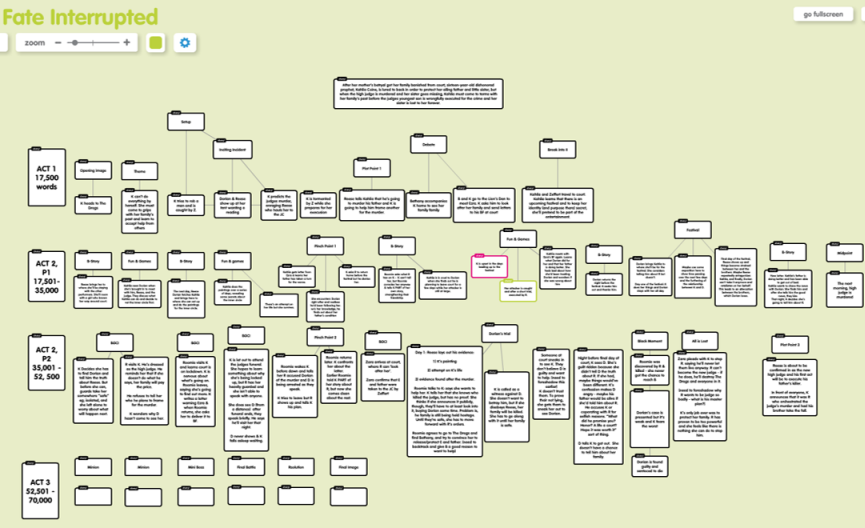
So here's what I did. AKA The Process
(At the bottom of this section, there’s a pic of what the *mostly* final board looks like)
Step 1) I wrote a
few sentences about each scene I knew would be in the book. Each scene got its
own little bubble.
I’m a fan of 3 Act structure, because it gives me a
reference for where things need to happen and keeps the story pacing on target.
For instance, if I’m shooting for a 70K word novel, I want the first act to
take approximately ¼ of my total word count, which brings me to:
Step 2) I created
4 new bubbles: ACT 1, ACT 2 Part 1, ACT 2 Part 2, and ACT 3. Then I sorted my
scene bubbles beside the act I felt they would fall into.
I also really like the Save the Cat beat sheet. Just like with using 3 Act structure, Blake Snyder’s beat sheet helps me pace
reveals and plot points so they are staggered throughout each act. Writer and
blogger Jamie Gold has an awesome downloadable beat sheet, which she adjusted
for novel writers. (Plus she has bunch of other goodies there as well, so you should totally check
it all out.)
Step 3) I created
new bubbles for each beat I wanted to hit in the book and used them as headers,
connecting them with the scenes I’d already included.
At this stage, I didn’t have enough ‘beat’ scenes written
yet. This was my first clue that had I already started writing, I’d be missing
essential story elements that I wanted to include. I was thrilled to discover
this now instead of later.
Step 4) Filled in
the remaining beats with new scenes.
Step 5) Evaluated
the big picture with a focus on the timeline of events and reordered and/or
added new scenes in order to create a realistic timeline.
Ex: there’s a section
of the story where the POV character needs to write and receive a series of
letters. It’s a day and a half journey one way from sender to receiver, and I
realized that in my budding outline I had letters coming and going WAY too
quickly. She was receiving replies to her correspondence before her letter
could have reached its reader. This could have been a giant problem had I
figured this out after completing the first draft. I got off my butt and happy
danced over discovering and fixing this issue ahead of time.
Step 6) I looked
at scenes that were weak. These said something vague like: Two days pass leading
up to (event) and MC is upset about X. I fleshed these
out into actual scenes and found that these were good spots to advance the subplot, which at that point was still pretty light.
Step 7) Checked
all major plot points, reveals, pinch points, and twists were evenly spaced and
adjusted where necessary. (And oh, there was lots of adjusting)
Step 8) Once the main
plot, sub plot, and timeline were solid and evenly paced, I considered other
details like where more foreshadowing was needed in order to build to certain
reveals, and I added notes about which scenes could support that info.
Step 9) A little
estimating is required here. I evaluated each scene and decided whether it was
enough to support an entire chapter or whether it needed to be connected with
the scene beside it. Knowing about how long my chapters run and my aim for the
final word count of this book, I estimated needing at least thirty chapters to
get me to The End. I was close, but
needed a little more and spent some time seeing what could be added to either
make new scenes or flesh out existing scenes into standalone chapters.
*When I was finished and ready to move onto phase two, my
Popplet looked like this:
(Note 1: yes, Act 3 is empty. Endings are my nemesis and I
simply cannot fully plot them out in advance. So even though I’m hardcore
plotting this book, there will still be some pantsing involved.)
(Note 2: this process took about a week to complete
Step 10) I did this part in MS Word due to a heartbreaking
loss of work in Scrivener that I haven’t completely recovered from. *wipes away
fresh tears*
Personally, I’m not good at working with two documents. Now
that I had everything plot-wise setup, I wanted to transfer it to my working
document. If you’re working in Word, the navigation pane is your best friend.
Learn it, live it, love it. For reals. If you’re not familiar with the
navigation pane, there are lots of tutorials out there. Bottom line is that you
need to use headers to make it work for you. Doing this allows you to jump
around your document without wearing out your mouse’s scroll bar.
I modified my heading styles to look like this
New Act’s are heading 1, all
standard chapters are heading 2, a plot point or pinch point chapter is header
3 or 4 respectively, and my outline and any other documents notes I add are heading
5.
Then I typed in my Act
numbers and chapter headers in their appropriate headings, and then copied and
pasted each scene from Popplet under the chapter it belongs with. When that was
done, my navigation pane looked like this:
Setting up the document this way makes moving around it easier, which is a huge time
saver once the word count begins adding up. Pasting each scene from Popplet
into Word was a bit tedious, however in long run, I’m glad I did it. I can
click on anything in the navigation pane and jump straight to that section.
When I get there, I know exactly what I need to write about.
I’d never written
out of order before, because as a pantser, I had only a bleary idea of what would happen a scene or two past
what I was currently working on. This time, I felt confident skipping from chapter 7 to chapter 20, because my outline is solid and I’ve already justified the inclusion of every single scene.
I'm finding the freedom to work on any story section I choose is incredibly freeing. Some days, an emotion-heavy scene might be right up my
alley, but on another day, I’m too drained to dig as deep as that sort of scene
demands. Now I have options, and my word count is increasing much
faster than when I my only choice was to write scenes in order.
Aaaand, that’s it. I’ll just add a quick shout out to a few
of my favorite books on plot and structure. Save the Cat and Save the Cat Strikes Back by Blake Snyder. Story Engineering by Larry Brooks. The Hero’s 2 Journeys
by Michael Hauge and Christopher Vogler. And lastly, K.M. Weiland’s entire blog,
but especially her Structuring Your Scenes series, which is ah-fricken-mazing.
I know this was a long post, and I appreciate you guys
sticking with me. I hope you found something in here that’s helpful. Now go
forth and write all the words!
Monday, July 21, 2014
Become An Honorary Revision Warrior
We have something to CELEBRATE! Revision Warriors has reached 20,000 page views. Wahoooo!
I know, right?! TWENTY THOUSAND is a big number.
But wait, there's more! Our very own, super fabulous RW'er, Michelle Smith, just released the cover of her book Play On due out in April 2015. Show Michelle some love and add it to your TBR list: Goodreads
To show our how much we appreciate everyone’s support, we want to invite two people to become honorary revision warriors for a day. Whoop, whoop! *fires confetti cannon*
At the bottom of this post, there’s a Rafflecopter widget thingy (totally the official name, btw. ;) ). You can sign up anytime between now and Sunday, July 27th at Noon ET, and we’ll pick two winners that’ll receive a 3 page critique from a mix of revision warriors. Click here to check out our bio’s.
Fun, right?
Now for the official stuff:
• Critique will be of the first three double spaced pages of your manuscript. We’ll ask the winners to submit their pages within 72 hours after notification.
• Completed manuscripts and WIP’s alike are welcome.
• Your pages with our comments will appear on the blog. Critique is learning process for everyone, not just the author receiving feedback, and not everyone has amazing critique partners. We want to show what that process looks like. If you’re not okay with your pages appearing publicly, please do not enter.
• Blog readers will be encouraged to leave respectful, constructive comments. If that makes you uncomfortable, please do not enter.
• Winners will be announced on the blog July 28th. We’ll also email winners with additional details, like how to get your pages to us. *Make sure you leave your email address with your entry * If we do not have your email address, or don’t hear back from you within 72 hours, another winner will be chosen. *
• Critique #1 will go live on the blog Monday August 11th and Critique #2 will be Monday August 18th.
- Because this is all about YOU, we want to make entering easy. Just leave a comment telling us you want to enter and fill out the Rafflecopter with your name and email. Tweeting and/or spreading the news about the giveaway is not required (but it is appreciated. hint, hint.)
Again, we’ll contact the winners directly to discuss the who, when, and where, so please, please, please, make sure to leave your email.
Okay, on to today’s post. Because this blog about all things writing and revising, and we’re doing this fancy critique giveaway, I’m going to talk a little bit about critique groups. It’s kind of a big topic, so this is more like the tip of the iceberg, but if you're thinking about joining an established group or maybe starting your own, here are some things to think about.
Why are you seeking a critique group?
The obvious answer, of course, is to make your writing better. But can you dig deeper here? Better, how? Plot holes, character development, world building, dialog, pacing, grammar? Are any of these areas your specialty? Understanding your strengths, weakness, and what you hope to get out of a group, is a big step toward finding your people. And yes, my CP’s are definitely my people. #CPLOVE, FTW
Once you know what your needs are and what you can offer others, here are some more things to consider:
How much time can you dedicate to a group?
Joining or starting a critique group is a commitment, both of your time and the time of others. Respect that. Yes, sometimes life happens, but for a group to stick together long term, everyone involved is responsible for doing his or her part.
• How often does the group meet? Weekly, biweekly, etc.
• Will you meet in person or online to discuss critiques? If online, what service will you use? GChat, Google Hangout, Skype?
• Will there be written critiques? If so, how will those be handled?
• When is the submission deadline?
• When are critiques due?
• For written critiques, will you setup a Google or Yahoo group? Email only?
• Are there word count limits.
What can be submitted for critique?
• Will any genre be off limits?
• Any content restrictions?
• Are all categories accepted? A, NA, YA, MG, PB
• Are short stories, poetry, queries, and/or synopses acceptable for submission to the group?
How will online critiques be run?
• Is there a group leader?
• How will you ensure that time is used efficiently?
• Will you focus on big picture issues and leave nit picks and grammar for the author to read on their own?
• Is there a time limit for each critique?
Some final thoughts for critique-givers and receivers:
• In the end, only you know what is best for your story! Use the comments that resonate with you and don’t worry about the rest.
• Critters, understand that a suggestion you gave may not be used, and that’s perfectly okay. Our job is to offer our help, not make another author’s story into something we would write ourselves.
• NEVER share another author’s work with anyone outside of the group. This one should go without saying, but I’ve heard horror stories so I’m throwing it in here.
• Be vocal.
o Be polite, but don’t be afraid to ask for what you need. You are responsible for making your writing better and getting the most out of your group. If you have specific areas you want feedback on, let the group members know.
o The opposite is also true—if you do not want certain types of critiques, make that clear with your submission. Ex: This is a first draft. Please don’t focus on grammar.
• And most importantly, respect your group members. I cannot stress this enough. Be kind, supportive, and constructive. Always.
Okay – that was way more than I meant to write, and it’s only the starting point! If you have any questions about joining or starting your own group, please ask in the comments. We’d love to help! Or if you have experiences about critiquing you’d like to share, we want to hear ‘em!
And without further ado, Rafflecopter widet thingy is below. Please don’t be shy about entering! We won’t bite, I promise.
Monday, July 14, 2014
Give Your Brain a Break
A while back, I came across a blog or tweet that mentioned The Pomodoro Technique by Francesco Cirillo. For those of you who aren't familiar with the Pomodoro Technique, it's simply one way to produce more while avoiding the "my brain is fried" syndrome.
The Simple Steps:
1. Choose a project from your to-do list.
2. Set a timer for 25 minutes.
3. Work on that specific project until the timer beeps.
4. Take a 5 minute break and work on something unrelated. (Check email, listen to a song, unload the dryer, stalk someone on Twitter...)
5. After four 25 minute increments, take longer breaks between projects.
It's a great way to redirect your thoughts, much like sniffing coffee beans between smelling perfumes. I unofficially started practicing The Pomodoro Technique, and I've noticed that my brain isn't as tired after 30 minutes of work. When I go back to my project after a short siesta, I have a fresh perspective.
Try the Pomodoro Technique if you're experiencing brain freeze, writer's block, or seem unproductive. I've also used this with my kids when we do homework. It works great for them!
Have you noticed a change in your writing since the summer has started? What do you do to help increase your productivity? Any tips to share?
Monday, July 7, 2014
Writing Services
![]() |
| Abe Lincoln said, "Don't Believe Everything You Read on the Internet." |
I inadvertently stumbled on a site offering seminars, critique
services, retreats... You name it, this with the Utopia for writers and the
website looked great! When I saw the organizer's / presenter's name I was very
surprised. I knew this individual. And I knew this individual had been writing
for less than a year and a half. In fairness, I haven't spoken with them for a
while so perhaps since I worked with them, they've absorbed the knowledge to
charge other writers for their services. But still, I wondered how many people would
be handing over their money if
they knew how little experience this individual had.
There are hundreds of writing classes and editorial services
for writers. These can be great opportunities to refine your craft or to get
your work in the best possible shape before you start querying agents. I've had
the pleasure of working with a few and LOVE LOVE them. These mentors not only provided
detailed feedback on my manuscript, but through their critique, they taught me
to be a better writer. But before you spend money on an editorial service,
seminar or manuscript critique, you might want to keep a few things in mind.
Don't let a professional looking website sway your decision.
Seriously, the days of crappy sites being tell-tale signs of an unprofessional are
long gone. Many domain services have user friendly programs and affordable website
design services. Remember, you don't have to be a full-scale, non-profit
organization to take a (dot)org domain.
Is this individual's work something you enjoy and have any
of their clients experienced success? Testimonials are great -- but the proof
really is sometimes in the pudding. Don't be afraid to ask questions.
There are also awesome groups out there that have Writer
Beware sites that track and expose questionable activities and / or scams in
the writer industry. Here are a few:
Of course, before you pay for a service, get your work in
the best possible shape you can. That way you can really get some bang for your
buck. Here are some great ways you can do this.
1. Join a critique group. Other fellow writers like yourself
are a great source for cleaning up your manuscript. If there's not a group in
your area, start one. Ask local librarians and book store owners if you can put
up a flyer. If there aren't enough writers in your area, establish an online
writing group. You can find other writers at great sites like Absolute Write and Twitter.
2. Join a professional organization that fosters a community
of persons within the industry. There may be an annual fee but that typically
includes a magazine subscription and / or online resources, member discounts on
conferences etc. I've been a member of SCBWI since 2010. One of the best decisions I made when I began
writing.
3. Can't afford to go to a
conference but want to participate in one? Look for online conferences. Children's writers should check out WriteOnCon. It's awesome and it's free; however, please try to donate what you can.
4. Make connections on social networking sites like Twitter.
There are great opportunities out there. Writer blogs that are dedicated to
helping writers make connections and improve their work. Again, beware of
anyone asking for money -- these are typically free. There are too many for me to
mention here, but a few of my favorites include Brenda Drake and Cupid's Literary Connection
Through organizations and communities such as these, I've met
mentors and even some of my amazing critique partners. And as I wrap up this
post, I have to give kudos to my very first mentor. Joyce Sweeney is AMAZING. Seriously, not only is she an extremely talented teacher, but she
is one of the kindest people I've had the pleasure to meet. I strongly
recommend her services -- you will not be disappointed.

Monday, June 9, 2014
6 Tips for a Cleaner Manuscript
We all love all our words, don't we? But sometimes, things must be cut in order to fit our manuscripts into a certain word count, or maybe our critique partners are sobbing because there is too much AYKB (as you know Bob) and repetitive description.
Here are some ideas to make your manuscript shine! (Your readers will thank you!)
1. Make sure you have formatted correctly. The BASICS:
-12-pt Times New Roman black font
-one inch margins on all sides
-align left
-double space (no extra space between dialogue)
-single space after periods
-indent (5 spaces/ half inch) new paragraphs
-scene breaks are marked with a # in the center of the line
-align header to the right and include your last name/title (or key words)/page number except title page
-chapters begin on new pages about a third of the way down
Always check an agent's/publisher's site for more tips on how they want your ms formatted!
2. Unnecessary backstory. Yes, I know you want to tell me about your hero's birth, but is it necessary explain it all in the first 20 pages? Get to the action of the story that you're telling now. Backstory can be woven in and revealed as the story progresses if it is essential.
3. Repetitive details. This is a hard one. I'll give some examples.
Marsha sat at the diner booth and ordered a strawberry milkshake.
"So, that's one strawberry milkshake," the waitress said.
-OR-
Sally walked into the hardware store. She scanned the isles looking for a wrench. Thehardware clerk asked if she needed help finding anything.
-OR-
Ned thought his situation was dire. He Ned was stuck in the canyon without water, food, or shade. There was no shade. No food. What was he supposed to do?
See? Some things don't need repeating. Usually these details are hidden within the same paragraph or on the same page. Trust your reader to understand the story, emotions, and details. This also helps with author intrusion. :)
4. Seek and destroy passive voice! Look for these words, mostly to-be verbs (was, were, are, that, etc.), and try to restructure your sentences to make them more active. Marlana wrote an awesome post about how to find passive sentences if you need more clarity.
You were not at work today. vs. You missed work today.
You must clean your room. vs. Clean your room.
5. Limit the amount of metaphors you use. Everyone enjoys a comparison of objects, but not every other sentence or paragraph. However, one of my critique partners pointed out that Mark Zusak used tons of metaphors in The Book Thief and got away with it. I concur. I hardly noticed them. So if you're Mark Zusak, you can use as many metaphorical passages as you desire. :)
6. As You Know Bob (AYKB)
"Douglas, did you see how the commander reacted to the new general? She nearly peed her pants."
"Yeah, Bob, I did see. I think she did wet her pants. I was at the back of the line when the general walked in though, so I might not have had the best view."
"Hey, Douglas, I think it was because of his large head. She couldn't contain the laughter."
"Sounds right, Bob. I saw her shoulders shaking."
Please don't write dialogue like this. Here's a rewrite without AYKB.
The general's head was shaped like a watermelon, stretching over his decorated shoulders. The commander could not laugh. Melon wasps stung any moving object.
How about you? Are you trending a new style of writing that your critique partners just don't get? Have you sent an ms out in 18-pt Kefa font in purple to an agent? We'd all like to know. ;)
Here are some ideas to make your manuscript shine! (Your readers will thank you!)
1. Make sure you have formatted correctly. The BASICS:
-12-pt Times New Roman black font
-one inch margins on all sides
-align left
-double space (no extra space between dialogue)
-single space after periods
-indent (5 spaces/ half inch) new paragraphs
-scene breaks are marked with a # in the center of the line
-align header to the right and include your last name/title (or key words)/page number except title page
-chapters begin on new pages about a third of the way down
Always check an agent's/publisher's site for more tips on how they want your ms formatted!
2. Unnecessary backstory. Yes, I know you want to tell me about your hero's birth, but is it necessary explain it all in the first 20 pages? Get to the action of the story that you're telling now. Backstory can be woven in and revealed as the story progresses if it is essential.
3. Repetitive details. This is a hard one. I'll give some examples.
Marsha sat at the diner booth and ordered a strawberry milkshake.
-OR-
Sally walked into the hardware store. She scanned the isles looking for a wrench. The
-OR-
See? Some things don't need repeating. Usually these details are hidden within the same paragraph or on the same page. Trust your reader to understand the story, emotions, and details. This also helps with author intrusion. :)
4. Seek and destroy passive voice! Look for these words, mostly to-be verbs (was, were, are, that, etc.), and try to restructure your sentences to make them more active. Marlana wrote an awesome post about how to find passive sentences if you need more clarity.
You were not at work today. vs. You missed work today.
You must clean your room. vs. Clean your room.
5. Limit the amount of metaphors you use. Everyone enjoys a comparison of objects, but not every other sentence or paragraph. However, one of my critique partners pointed out that Mark Zusak used tons of metaphors in The Book Thief and got away with it. I concur. I hardly noticed them. So if you're Mark Zusak, you can use as many metaphorical passages as you desire. :)
6. As You Know Bob (AYKB)
"Douglas, did you see how the commander reacted to the new general? She nearly peed her pants."
"Yeah, Bob, I did see. I think she did wet her pants. I was at the back of the line when the general walked in though, so I might not have had the best view."
"Hey, Douglas, I think it was because of his large head. She couldn't contain the laughter."
"Sounds right, Bob. I saw her shoulders shaking."
Please don't write dialogue like this. Here's a rewrite without AYKB.
The general's head was shaped like a watermelon, stretching over his decorated shoulders. The commander could not laugh. Melon wasps stung any moving object.
How about you? Are you trending a new style of writing that your critique partners just don't get? Have you sent an ms out in 18-pt Kefa font in purple to an agent? We'd all like to know. ;)
Monday, June 2, 2014
Passive and Active Voice
I
love to write a few chapters and then go back and search for passages that can
be reworked to sound less passive. Passive voice can be *yawn* boring. So what
is passive voice? There are several
definitions out there – but my favorite is straight and to the point.
Passive
Voice: When you make an object of an action into the
subject of a sentence. So whoever or
whatever is performing the action is not the grammatical subject of the
sentence.
Why
is passive voice sometimes frowned upon? Because it often forces your reader to guess what you mean and quite
honestly, these passages often lack pizzazz. This is because the subject’s be-er or do-er isn’t moving the sentence
along but the subject of the sentence is acted upon by some other agent or by
something unnamed.
There
is an easy way to find these annoying little passages. Look for a form of “to be” followed by a past
particle. “To
Be” verbs: has been, have been, had been, will be, will have been, are, am, is, was, and were.
I
*heart* Control + F so I can search for them. I’m not always able to get rid of
all of them and that's okay too.
I
learn best through example. Here are a
few I found surfing the net.
Active:
Why
did the chicken cross the road?
Passive:
Why
was the road crossed by the chicken?
Active:
The
auditor approved the new budget.
Passive:
The
new budget was approved by the auditor.
Active:
Ben
showed me his new car.
Passive:
The
new car was showed to me by Ben.
Active:
I
washed the dishes this morning.
Passive:
This
morning the dishes were washed.
For
those of you searching for passive passages within this blog? Eh- yeah.
I’ll get right on that.

Monday, May 12, 2014
Make Time To Do What You Love
We all get the same 24 hours a day. We
mark the passing seconds, minutes, and hours almost obsessively. Seriously,
take a second to think about how many clocks you have in your house—wall
clocks, watches, phones, computers, oven, microwave, alarm clocks. There’s a
clock in your car, there are electronic roadside signs displaying the time. It’s
craziness!
So why it is so hard to accomplish everything you NEED to do and
everything you WANT to do each day? “Time got away from me” is a favorite saying of mine, but how
can time escape my attention when I'm constantly reminded of it? Why do I feel
like there is never enough time for me to WRITE?
“I must
govern the clock,
not be governed by it.”
~ Golda
Meir
You only get one life. Shouldn’t the majority of it be spent doing
the things you love? Here are a few things I do in hopes of making that happen.
Audiobooks
LibriVox provides free audiobooks from the public
domain that read by volunteers. How great is that?! Many classic books are
available for download in several different formats; I have the app on my
iphone, and I’ve listened to Jane Eyre and Pride and Prejudice during my
commute to the day job. These are two books I’ve wanted to read for like… ever,
and LibriVox made it possible. For free. And you can’t beat free, right?
I also subscribe to Audible and
pay a monthly fee of $14.99, which gives me 1 credit every 30 days to download
a current title. As much as I love physical books, I wouldn’t get to enjoy as many
stories as I do if it weren’t for Audible. Now I listen to books while I’m
cleaning the house, doing dishes, cooking dinner, driving to work, etc.
“Much may be done in those little shreds and patches of time which every day produces, and which most men throw away.”
~ Charles Caleb Colton
Make use of the small blocks of time
There was a time, not
so long ago, that I didn’t realize what I could accomplish during those 10
minute breaks I had at work, or the time I spent waiting during my son’s karate
class. Now, during my breaks (thanks again to my iPhone) I read blogs,
check emails, jot down ideas, and check my twitter & Facebook.
I have 45 minutes twice a week during
my son’s karate class. That’s an hour and half a week, folks! When I was editing
my WIP prior to querying, I sent a copy of it to my Kindle app so I could read
and catch errors while sitting in the waiting area. Now I use it to brainstorm
new story ideas.
“For disappearing acts, it's hard to beat what happens to the eight hours supposedly left after eight of sleep and eight of work.”
~ Doug Larson
Put yourself first
This is a big one,
and it can be a toughie because we’re so used to making sure everyone else is
taken care of before our own needs are met. All you moms and dads with
kids out there know EXACTLY what I mean.
Sometimes it’s okay to say NO to
stuff. No, this weekend the sleepover isn’t going to be at our house. No,
this time you need to ask your friend’s parent for a ride to the mall. It
really isn’t selfish to not do everything all the time. There must be some balance. Embrace it. Love it.
Live it.
Treat writing like a job
Even if you’re not
paid to do it. My husband laughed at me the first time I told him that I work
two jobs. He wasn’t trying to be mean or insensitive. He just didn’t get it at
first. But when I began to take it seriously, he did too. Now, he respects the
time I set aside for writing. But it had to start with me. Others won’t take
you seriously if don’t give them a reason to.
Fact: writing is my second job. For now. One day, I
hope will be my primary job. Why wouldn’t I treat it just as seriously as
anything else I do? Why should the thing I want most come second to
everything else?
Make a schedule if that works for you,
but whatever you do, make it a priority. Don’t treat writing as something that can
be pushed off to the side.
“Work is hard.
Distractions are plentiful.
And time is short.”
~ Adam Hochshild
I guess
what it comes down to is that time isn’t going to find us; we have to make the
time. This may mean sacrifice, like watching less television or playing
fewer video games (man, I love video games). Sometimes it means getting
creative and finding ways to kill two birds with one stone, like listening to
audiobooks while driving to the day job.
In the
end, we all choose what’s important to us and ultimately what we make time
for. Every time I choose to do something else over my writing, I ask
myself if what I’m doing is more important. Sometimes the answer is yes,
but many times it’s no. Those are the times when I need to force my BICHOK (but
in chair, hands on keyboard).
Are the 24 hours we get each
day enough for you? Please share any tips you have to stretch the
time and fit it all in.
Subscribe to:
Posts (Atom)


.png)